Explorer Kino Explorer
Explorer Section Page

Kino Crossing the Colorado River
Artist José Cirilo Ríos Ramos
Explorer Section Page Links
Life Section Page Links
Website Page Links
- 'Home Page
- 'Page Index
- Best Concise Biography
- Best Book El mejor libro sobre Kino
- Best Book Entire Online English
- Best Book Guide Section Page
- Best Book Reference Map & Timeline Links
- Best Book^ Online Table of Contents
- Best Book^ C01 California Mission
- Best Book^ C02 Indians Not Slaves!
- Best Book^ C03 Among The Pimas
- Best Book^ C04 Young Lieutenant
- Best Book^ C05 Blood of a Martyr
- Best Book^ C06 Vengeance!
- Best Book^ C07 Children Ask For Bread
- Best Book^ C08 Error in the Map
- Best Book^ C09 Devil's Highway
- Best Book^ C10 Visit from Salvatierra
- Best Book^ C11 Plan for New Spain
- Best Book^ C12 General Manje Writes Report
- Best Book^ C13 Francis Xavier Chapel
- Best Book^ C14 Best Book Index
- Best Book^ C15 Author Bio & Note
- Biografía de Eusebio Francisco Kino
- Biografia di Eusebio Francisco Kino
- Biography of Eusebio Francisco Kino
- Builder Architect
- Cabalgata Rides 01
- Cabalgata Rides 02
- Cabalgatas Section Page
- California Builder
- California Founder
- Cartographer
- Cross References To Books
- El romance del Padre Kino Book
- Europe Son
- Expanded Table of Contents
- Explorer
- Explorer Baja California Gulf of California
- Explorer Colorado River and Delta
- Explorer Pinacate & Gran Desierto
- Explorer Sonora Arizona
- Farmer Rancher
- Favores Celestiales Bolton
- Friend and Defender
- Grave Discovery Anniversary Blog
- Grave Discovery Chapel
- Grave Discovery History
- Grave Discovery Olvera Account
- Historian
- Horseman
- Jesuit Exemplar
- Jesuits on the Pacific Bolton
- Kino Biography
- Kino Heritage
- Kino Life
- Kino Life Summary Maps
- Kino Resources
- Kino Wheat
- Letters To Duchess Aveiro
- Literature Bibliography
- Magdalena de Kino - Trails End
- Magdalena Pilgrimage
- Mission San Xavier del Bac Statue Guide
- Missionary Father
- Multimedia Online
- National Parks and Heritage Areas
- O'odham People
- Pageant Play "Bell and Plow"
- Remembrances on the Trail
- Ride for Justice History
- Ride for Justice Journeys
- Sainthood Cause
- San Cayetano Tumacacori
- San Xavier del Bac
- Scientist
- Segno - Birthplace
- Sor Juana's Kino Poem
- Sortillion^ C01 El Joven Kino
- Sortillon Kino Website
- Statues Monuments
- Testimonials
- Timeline
- Tumacacori
- U.S. Capitol Statue Section
- U.S. Statue Burrus Dedication
- U.S. Statue Hayden Acceptance
- U.S. Statue Silver-Cruys Sculptor
- U.S. Statue Udall Interior Secretary
- U.S. Statute Goddard Presentation
- U.S. Statute Green Invocation
- Website Page Index Annotated
Explorer Section Page Links

Kino Travels in New World
Spanish Royal Ordinances Governing Discoverers and Their Explorations
Law of Indies 1573
Jorge Olvera
|170| Philip II, for his part,wished to avoid disorderliness when he published his Ordenanzas Reales (Royal Ordinances) in his Leyes de Indias (Laws of the Indies) on July 13, 1573. These ordinances prescribed a series of steps to be taken in creating settlements in the recently conquered lands. ...
It is possible to discern how closely Kino followed the Ordenanzas Reales as soon as he was authorized by the Spanish crown, through viceregal authority and his religious superiors, to found new missions in the Pimeria Alta. Kino, especially as the discoverer and settler of what to Spain were new and unknown lands, was expected strictly to adhere to Las Leyes de Indias.
Ordinance Number 1 stated: “No person, without our authorization, can make a new discovery, nor entry, nor establish a new settlement, hamlet or camp or rancheria in that which is already discovered, under penalty of death and confiscation of property; but in that which is already discovered, the governors can authorize whatever new settlements that are convenient, sending us a descriptive account of it as soon as possible.”
|171| Under Spanish law, Kino became 1) a discoverer, 2) an adelantado, or the advanced governor of a province to be discovered, and 3) a missionary for the spreading of the Gospel.
Ordinance Number 14 said, "The discoverers with the officials will name all the land discovered, [including] each province and the mountains and most important rivers."
Accordingly, Kino named the region the Pimeria Alta and proceeded to name its rivers, mountains, and Indian settlements. In naming the latter, he preserved the Indians' names for their own communities, joining them with a Christian name and thereby bestowing Christian patron on the village. He did this when he added the Christian name Santa Maria Magdalena to the Indian settlement of Buquivaba (Santa Maria Magdalena de Buquivaba). From his diary, we know he did the same for dozens of other places, including Nuestra Señora de los Dolores de Cosari (or de Bamotze), Nuestra Señora del Pilar y Santiago de Cocospera, San Xavier del Bac, and San Pedro y San Pablo del Tubutama.
Like a new Adam who was given the privilege by God of naming everything in the newly created paradise, Kino also labelled the rivers, mountains, and even such sites in the desert as water holes or sandy areas.
Ordinance Number 26 shows the importance placed by the Spanish crown on members of religious orders in the discovery and settlement of the New World: "Before entrusting the discovery to others, put it under the care of those friars who would wish to do it and give them all facilities and security at our cost."
Once the missionaries or civilians were in charge of the discoveries and settlements, several ordinances came into play. Among the more important were the following:
Ordinance Number 29: "The discoveries should not be called conquests, for they have to be made in peace and charity."
Ordinance Number 30: "The discoverers should keep these ordinances, especially those that are favorable to the Indians."
Jorge Olvera
Finding Father Kino:
The Discovery of the Remains of Father Eusebio Francisco Kino, S.J. 1965-1966

Bolton's Kino Route Map from "Kino's Historical Memoir"
Links To Kino Route Maps In High Resolution
"The Rim of Christendom: a Biography of Eusebio Francisco Kino, Pacific Coast Pioneer"
Collection From Book's Back Pocket
The University of Arizona Campus Repository
Pima Land, 1687-1711
Compiled by Herbert E. Bolton, 1936 (13 MB)
Click to download
http://arizona.openrepository.com/arizona/handle/10150/623457
Kino's Teatro de los Trabajos Apostolicos
Eusebio Francisco Kino
Drawn in 1695-1696.from the original manuscript (9 MB)
Click to download
http://arizona.openrepository.com/arizona/handle/10150/623456
Bolton Map Collection Page
Links On One Page To Access All Three Maps
The University of Arizona Campus Repository
Click to access repository page
http://arizona.openrepository.com/arizona/handle/10150/623454
Pimeria Alta 1687-1711
Map compiled by Herbert E. Bolton, 1919 (1.5 MB)
An earlier version of the the 1936 "Pima Land 1687-1711" Map that accompanied Bolton's "Kino's Historical Memoirs"
Click to download
http://ccdl.libraries.claremont.edu/cdm/ref/collection/p15831coll14/id/131
Page Links to Detail Explorations
For all Pimeria Alta Expeditions
Click Explore Sonora & Arizona page
For more detail on the Pimeria Alta to Colorado River (Expeditions 23 through 29)
Click Explore Colorado River and Delta page
For more detail on Kino's 3 trips in the Pinacate Volcanic Fields and Gran Desierto
Click Pinacate and Gran Desierto page
Francisco Eusebio Kino - El Padre de Sonora"
Manuel de Jesús Sortillón Valenzuela
Excellent Route Maps and Biographical Summary in Spanish
In Spanish
"Francisco Eusebio Kino - El Padre de Sonora"
Manuel de Jesús Sortillón Valenzuela
Website, 2004
Excellent route maps Text based on Herbert E. Bolton's "Rim of Christendom" and Kino's writings with location photographs and beautiful art illustrations.
All 16 chapter links work. The Prólogo and Epílogo links do not work.
Click
Sortillion Kino Website page
Chapters:
1. El Joven Eusebio; 2. Un Viaje Demasiado Largo; 3. California, una Ilusión Inesperada; 4. Una Misión Imposible; 5. El Adiós a San Bruno; 6. Una Bahía para Kino; 7. Sonora Querida; 8. Buscando Almas; en la Pimería; 9. La Pimería en Revolución; 10. Un Perdón Enmedio de un Castigo; 11. Kino Cabalga de Nuevo; 12. Mas Viajes y Kino Descubre “El Pinacate”; 13. Juan y Eusebio Juntos de Nuevo; 14. La Aventura de las Conchas Azules; 15. Kino Pasa por Pitic; 16. Adiós Eusebio; Prólogo (not linked); Epílogo (not linked)


Topographic Map of Kino's Sky Island Mountains and Sonoran Desert
Topographic map shadow embossed on 1884 State of Sonora base map.

Kino Travels in Baja and Gulf of California
1681 - 1685


Kino Voyage To Spain 1678
Munich to Cadiz

September 27th Tucson Name Day and Día del Santo(s)
Kino Originates "Tucson" Name In 1692 Visit
Medicine Men - Kino and Tucson Patron Saints San Cosme and Damían
San Cosme de Tucsón Site Between Tumamoc Hill and St. Marys' Hospital
TWO CELEBRATIONS ON TUCSON’S SEPTEMBER 27TH NAME DAY - ORIGINS OF THE NAME “TUCSON,” FIRST WRITTEN BY KINO -- AND TUCSON’S DIA DE SANTO(S) - FEAST DAY OF KINO'S PATRON SAINTS OF TUCSON - "THE UNMERCENARY" MEDICAL DOCTORS SAN COSME AND SAN DAMIÁN. ¡FELIZ SANTOS TUCSONANS! HAPPY NAME DAY!
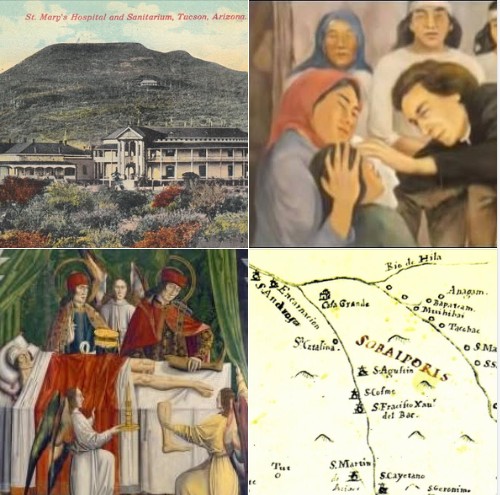
After accepting the invitation of the Wa:k community and visiting San Xavier del Bac in 1692, Kino was the first European to travel to the Sobaipuri O'odham village that he named “San Cosme de Tucsón.” The village’s name is the origin of the name for Tucson and its metropolitan area. In 2020, archaeologist and ethnohistorian Dr. Deni J. Seymour discovered the village at the north side base of the Tumamoc Hill Trinchera within yards of today's St. Mary's Hospital. See top left photograph of St. Mary's Hospital with Tumamoc Hill in the background. Nowadays a crowd of walkers daily pass near its location as they climb 700 feet on the 1.5 mile road mile to the top of Tumamoc Hill. Tumamoc Hill is an ecological reserve that is an active study area operated by the University of Arizona that allows walkers public access on its road.
The Sobaipuri O’odham called San Cosme de Tucsón “S-cuk Shon” meaning “black base.” It describes the black volcanic rock that covers the area and forms Tumamoc Hill. The village name S-cuk Shon is in the dialect of the Sobaipuri O’odham. Probably Kino heard S-cuk Shon “Tucsón” by the interpretation of the Soba O’odham into their own dialect. The Soba O’odham lived south of today’s Nogales. A large contingent of Soba leaders accompanied Kino on his first visit to Tucson.
______________________________
CELEBRATING THE ORIGIN OF THE NAME “TUCSON”
FIRST WRITTEN BY KINO - SEPTEMBER 27, 1698
Anthropologist and ethnohistorian Henry Dobyns described the origin of the name Tucson when he wrote “... on 27 September 1698, Kino and his military escort leader, Captain Diego Carrasco, made the first known written reference to Tucson. Kino called it San Cosme de Tucsón ... ”
Kino records that on September 27, 1698: “In that afternoon, we set out for San Augustín del Oyaur, having passed through San Cosme de Tucsón, through another ranchería, through many corn fields, through rich fields of beans, watermelons and squash which there are in the vicinity.” The site of San Augustín del Oyaur ranchería is now located in the Flowing Wells area of Tucson. Kino again refers to San Cosme de Tucsón in his later reports on his many visits to the desert oasis of Tucson and its Sobaipuri O’odham communities.
Before Kino’s written report of September 27, 1698, Kino's marked the location of San Cosme de Tucsón as "S. Cosfe" in his famous maps that he drew in 1695-1696. The bottom right image is a detail of Kino’s Padre Saeta Map drawn in Kino's own hand. He named the village in honor of the 3rd century CE saints Cosme and Damían, the patron saints of medical care providers and pharmacists. More discussion below
Kino wanted to live full time with the Sobaipuri O’odham of the Tucson area. His request to move his main mission headquarters to the Tucson area was approved by his superiors after a 1700 visit to San Cosme de Tucsón, but only if a replacement could be found for him at Mission Dolores. Although his replacement never arrived, the Sobaipuri O’odham of the Tucson area continued to travel throughout the year into today’s Sonora to help Kino plant and harvest crops, roundup cattle, build churches and meet with Kino’s superiors to show support for the charismatic Kino.
Somehow today’s City of Tucson and its metropolitan area has kept Kino’s spelling of “Tucson” after more than 300 years despite the fact that its location name has been spelled in many different ways. In later writings and maps by other Europeans, Tucson’s name has been written as Tupson, Tucsiom, Tucuson, Tucusona and Tuquisón.
______________________________
CELEBRATING TUCSON’S DIA DE SANTO(S)
KINO'S PATRON SAINTS OF TUCSON
SEPTEMBER 27TH FEAST DAY OF SAN COSME AND SAN DAMIÁN
"THE UNMERCENARY" MEDICAL DOCTORS
In Latin American, Spain and other countries of Europe, people celebrate their “el día de santo.” It is celebrated on the feast day of the saint that a person is named after. Also people celebrate the feast day of the patron saint of their communities. In English, the day is known as “Name Day.”
Tucson celebrates its día del santo(s) on the traditional September 27th feast day of San Cosme and San Damian. Before Kino’s written report of September 27, 1698, Kino's marked the location of San Cosme de Tucsón as "S. Cosfe" in his famous maps that he drew in 1695-1696. Dr. Seymour writes “Kino plotted the name ‘San Cosme’ on the earliest map of this region, attributed to 1695-1696, which is known to have incorporated information from Kino’s travels in this area from 1692.” The bottom right image is a detail of Kino’s Padre Saeta Map drawn in Kino's own hand. He named the village in honor of the 3rd century CE saints Cosme and Damían, the patron saints of medical care providers and pharmacists.
Why does Tucson have two patron saints when only the name San Cosme is mapped or recorded by Kino? Many times when San Cosme's name is spoken, people will automatically respond by saying "Don't forget Damián." Using only Cosme implies Damián since the twin brothers were inseparable in their work as healers and in their deaths as martyrs. Because doctors Cosme and Damián accepted no payment for their services, they were called "The Holy Unmercenaries" and "The Silverless." In English the saints are known as Cosmas and Damian.
It is appropriate that the European beginnings of Tucson started with Kino honoring the community with medical wonder workers as its patron saints. A major part of Kino's work as a missionary was to provide medical care to the sick and dying. In addition to being a missionary, Kino served the indigenous people as a medicine man - as a doctor & pharmacist. The top right image is a detail of a painting by Maestro José Cirilo’s Ríos Ramos depicting Kino caring for a sick child. More about Kino - the medicine man - at https://padrekino.com/index.php/khs_home/kino-life/kino-missionary
In modern times Tucson would become a mecca for medical and health care. It started in 1880 with the opening of St. Mary's Hospital and Sanatorium, just yards from the site of San Cosme de Tucsón. The hospital was founded by the Sisters of St. Joseph of Carondelet after their historic trek on foot and by wagon ten years earlier across the Sonoran Desert to Tucson from San Diego.
In the early 20th century, people suffering from tuberculosis or other lung disease migrated to Tucson seeking better health in Tucson's dry climate. At one time 20 percent of Tucson's population were tuberculosis sufferers living with their families. In the early 1960s Tucson became a pioneer center for open heart surgery. Ten years later it was a center for heart transplant surgery at the University of Arizona's Medical School. Also in the early 1970s the health care needs of many people in Southern Arizona were served by the innovative and community based Pima Care HMO which was one the first HMOs (health maintenance organizations) in the United States.
The image (bottom left) of San Cosme and San Damián in an operating room is from a detail of an altarpiece painting from a church in Spain. The painting illustrates the story of a miracle that the saints performed in transplanting a leg. A verger, a non-clergy church employee or volunteer, worked at the Church of San Cosme and Damián in Rome. He had a disease that was eating away the flesh of his leg. One night he dreamed that the doctor saints came to him and cut off his diseased leg. In its place, they transplanted the leg of man from Africa who had just been buried in a nearby churchyard. When he awoke, the verger found that he had a transplanted healthy leg and one of the dead man's legs was missing from his grave. It did not matter to the verger that the skin color of the transplanted leg did not match his other leg. He immediately jumped up in ecstatic joy and was able to walk. No rehab was needed.
In Tucson, San Cosme and Damián are honored with a chapel that is located at 460 W. Simpson Street in Barrio El Hoyo. The chapel is next to the city park named El Parque del San Cosme. The San Cosme Chapel has a similar footprint as the Kino hall-style churches in its dimensions. See Kino - Builder and Architect at
My discussion of the archeology and ethnohistory is based on my interpretation of the work of Dr. Deni J. Seymour. The rest of the post are my own observations. For more about Deni’s work finding Tucson’s birthplace, see the video entitled “San Cosme del Tucson: Tucson's Namesake and Birthplace” with presentations by ethnohistorians David Tenario and Tony Burrell at https://www.youtube.com/watch?v=2dOWxTtYx5E. Also read and download for free Deni's article entitled "Unveiling Tucson's Namesake: The Sobaipuri O'odham Village of San Cosme de Tucsón" at https://www.jstor.org/stable/45501894
Happy Name Day Tucson! ¡Feliz Santos! - Happy Saint’s Day Tucson on the Feast Day of San Cosme and San Damián! Kino’s Saints Are Always The Best!
September 27th Tucson Name Day and Día del Santo(s)
Kino Originates "Tucson" Name In 1692 Visit
Medicine Men - Kino and Tucson Patron Saints San Cosme and Damían
September 27, 2026
https://www.facebook.com/eusebio.kino.56/posts/pfbid0hyvqt53nd1eR9w1ZeHzu9JUTUt7DXjtbdfUa8otBkBevfzRYyqceZdYuvFpp4wEml