Jorge Olvera Account
Kino Grave Discovery
Page 3
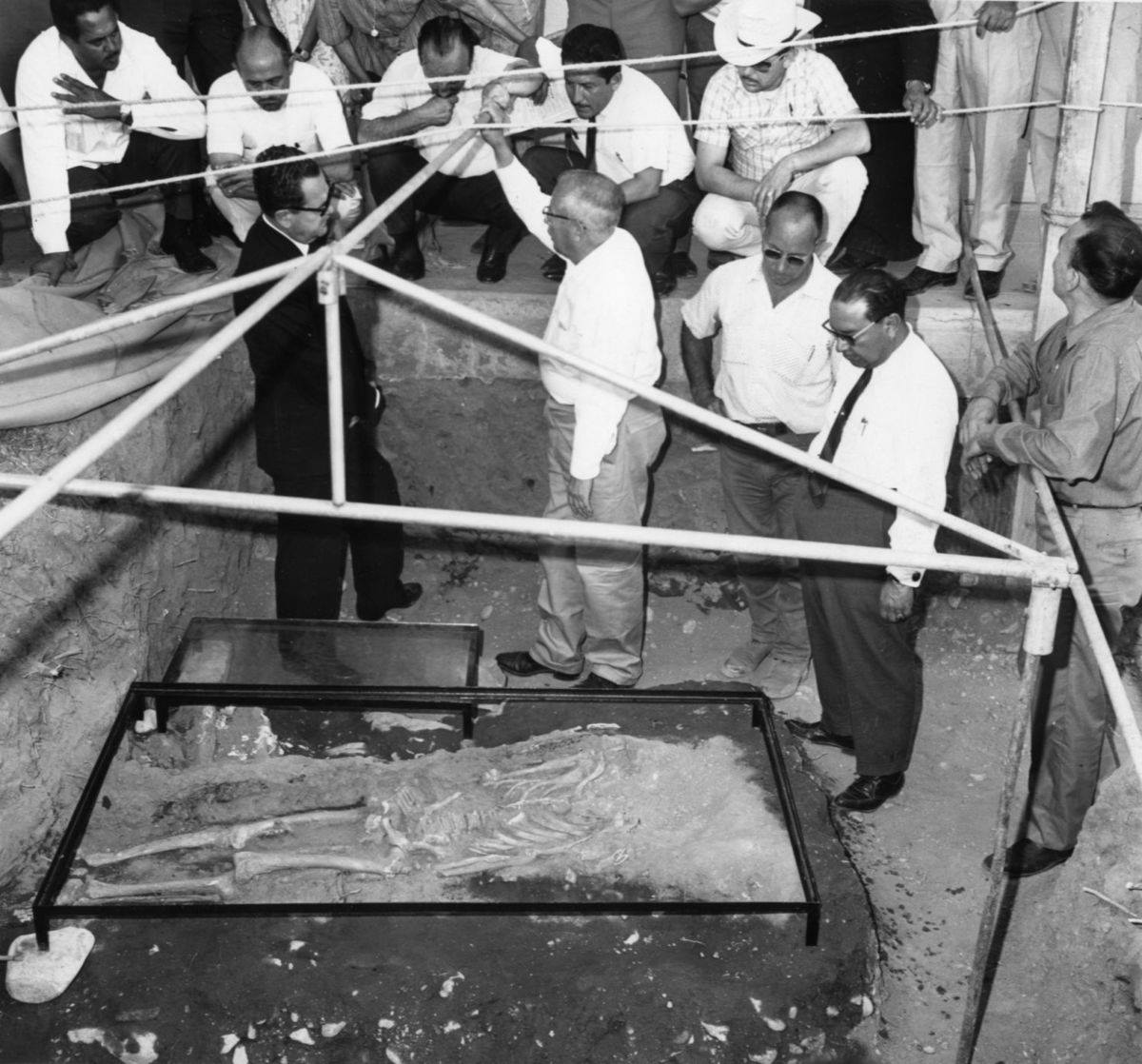
Kino's Skeletal Remains Found
Publicly Announced May 24,1966
Magdalena, Sonora
To Go To Kino Grave Discovery Site History (page1), click
Grave Discovery Site History Page
To Go To Kino Grave Discovery Chapel (page 2), click
Grave Discovery Chapel Page
To Go To Magdalena de Kino - Trails Ends, click
Magdalena de Kino - Trails End Page
To download "Archaeology Notes on the Discovery of Father Eusebio Kino" written by Dr. William W. Wasley in 1966, Click Archaeology Notes on Discovery of Kino by Wasley
Major Page Sections Links
Website Page Links
- 'Home Page
- 'Page Index
- Best Concise Biography
- Best Book El mejor libro sobre Kino
- Best Book Entire Online English
- Best Book Guide Section Page
- Best Book Reference Map & Timeline Links
- Best Book^ Online Table of Contents
- Best Book^ C01 California Mission
- Best Book^ C02 Indians Not Slaves!
- Best Book^ C03 Among The Pimas
- Best Book^ C04 Young Lieutenant
- Best Book^ C05 Blood of a Martyr
- Best Book^ C06 Vengeance!
- Best Book^ C07 Children Ask For Bread
- Best Book^ C08 Error in the Map
- Best Book^ C09 Devil's Highway
- Best Book^ C10 Visit from Salvatierra
- Best Book^ C11 Plan for New Spain
- Best Book^ C12 General Manje Writes Report
- Best Book^ C13 Francis Xavier Chapel
- Best Book^ C14 Best Book Index
- Best Book^ C15 Author Bio & Note
- Biografía de Eusebio Francisco Kino
- Biografia di Eusebio Francisco Kino
- Biography of Eusebio Francisco Kino
- Builder Architect
- Cabalgata Rides 01
- Cabalgata Rides 02
- Cabalgatas Section Page
- California Builder
- California Founder
- Cartographer
- Cross References To Books
- El romance del Padre Kino Book
- Europe Son
- Expanded Table of Contents
- Explorer
- Explorer Baja California Gulf of California
- Explorer Colorado River and Delta
- Explorer Pinacate & Gran Desierto
- Explorer Sonora Arizona
- Farmer Rancher
- Favores Celestiales Bolton
- Friend and Defender
- Grave Discovery Chapel
- Grave Discovery History
- Grave Discovery Olvera Account
- Historian
- Horseman
- Jesuit Exemplar
- Jesuits on the Pacific Bolton
- Kino Biography
- Kino Heritage
- Kino Life
- Kino Life Summary Maps
- Kino Resources
- Kino Wheat
- Letters To Duchess Aveiro
- Literature Bibliography
- Magdalena de Kino - Trails End
- Magdalena Pilgrimage
- Mission San Xavier del Bac Statue Guide
- Missionary Father
- Multimedia Online
- National Parks and Heritage Areas
- O'odham People
- Pageant Play "Bell and Plow"
- Remembrances on the Trail
- Ride for Justice History
- Ride for Justice Journeys
- Sainthood Cause
- San Cayetano Tumacacori
- San Xavier del Bac
- Scientist
- Segno - Birthplace
- Sor Juana's Kino Poem
- Sortillion^ C01 El Joven Kino
- Sortillon Kino Website
- Statues Monuments
- Test Page
- Testimonials
- Timeline
- Tumacacori
- U.S. Capitol Statue Section
- U.S. Statue Burrus Dedication
- U.S. Statue Hayden Acceptance
- U.S. Statue Silver-Cruys Sculptor
- U.S. Statue Udall Interior Secretary
- U.S. Statute Goddard Presentation
- U.S. Statute Green Invocation
- Website Page Index Annotated
Finding Father Kino: The Discovery of the Remains of
Father Eusebio Francisco Kino, S.J. 1965-1966
Book Cover Art Work
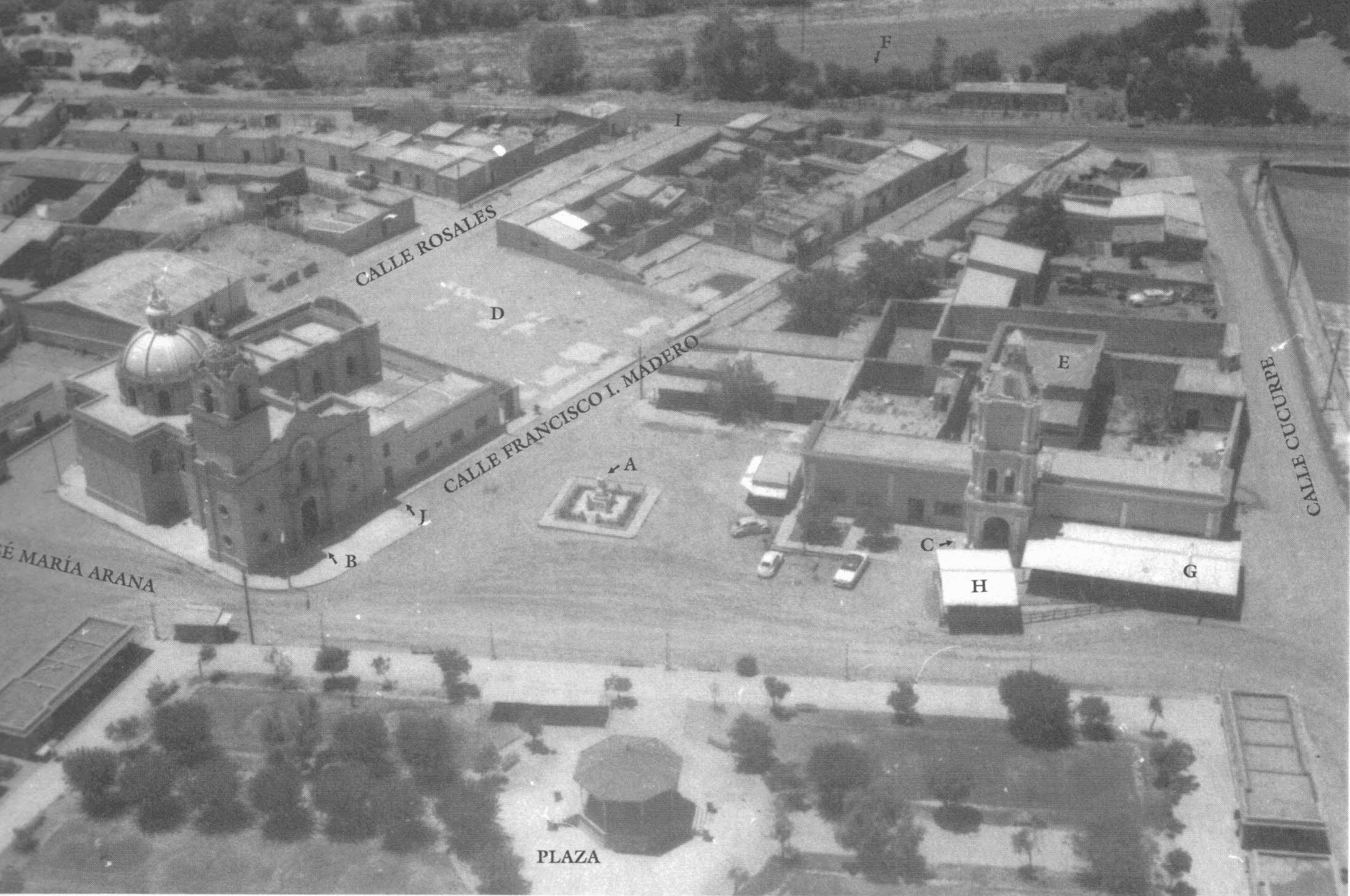
1967 Aerial View Of Magdalena After Kino Discovery - Figure 83
Aerial view in 1967 looking west over Magdalena de Kino, Sonora after the discovery of Kino's grave site and before construction of the new plaza in 1970.
The letters mark locations: (A) Old Kino monument. (B) Magdalena Church. (C) Palacio Municipal (City Hall) with clock tower. (D) Vacant lot. (E) Jail. (F) Rio Magdalena. (G) White roofed structure protecting Kino Chapel with Kino's remains. (H) White roofed structure protecting Campos Church. (I) Railroad tracks of the Ferrocarril del Pacifico. Entryway of (J) of church office of Magdalena Church. Front wall contained old arch that Olvera used as an architectural registration point for his Composite Sketch (Image 1). The location of Letter J is seen between Location B and the words "Calle Francisco I. Madero." Photographer Alexander Russell, Jr.
Thirty Meters (98 Feet) is the distance between (B) Magdalena Church (H) and Former Palacio Muncipal.
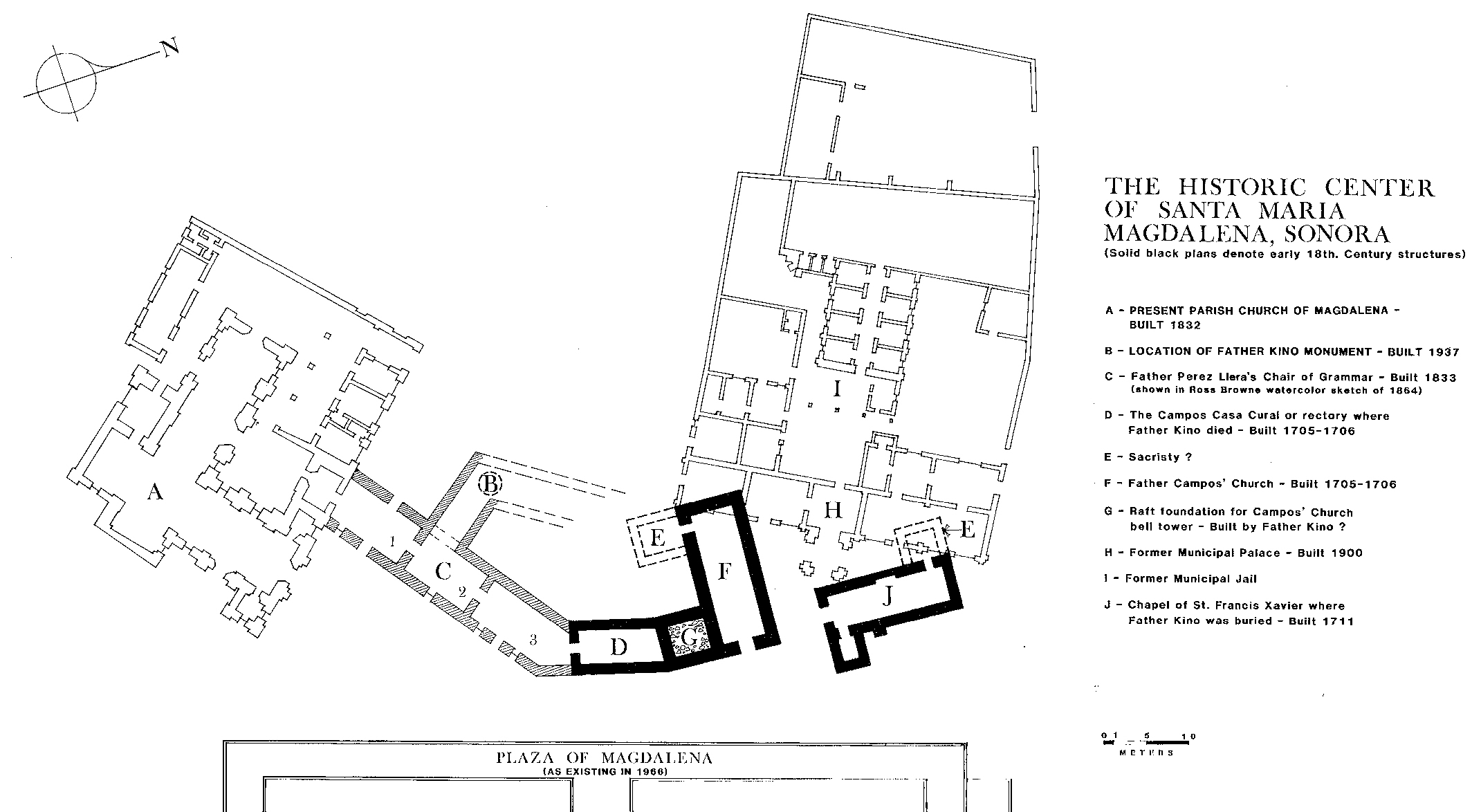
The Historic Center of Santa Maria Magdalena, Sonora
Solid Black Plans Denote Early 18th Century Structures
(A) Present Parish Church of Magdalena (1832). (B) Father Kino Monument (1937).
(C) Perez Llera's School of Grammar (1833). (D) Campos Casa Cural (1705-1706). (E) Sacristy ? (F) Campos Church and its (G) Tower Raft Foundation (1705-1706).
(H) Former Palacio Municipal and its (I) Jail (1900).
(J) Kino Chapel of San Francisco Xavier (1711).
Date When Structure Completed in Parenthesis.
30 Meters (98 Feet) Is Between (A) Present Church (H) and Former Palacio Muncipal
Notes on Building Terminology Identified Above
Editor Note: The Kino Chapel is also called "La Capilla" and "Chapel of San Francisco Xavier." Kino was buried in the Chapel after he dedicated it in 1711. It was destroyed completely in the earthquake of 1887 (J). The Campos Church was started in 1705 and its destruction date is unknown but it was before the 1879 Pinart drawing (F). City Hall is also called "Palacio Muncipal" It was built 1910 and demolished to build the Kino National Mausoleum and the Kino Monument Plaza in 1970 (H). Present Magdalena Church is also called "Santa Maria Magdalena Church." It was built in 1832 and is the present parish church and is located in the Kino Monument Plaza (A). The building footprints shown in bold solid lines existed at the time of Kino's death. The first phase of the Kino Grave Discovery Project was during the months of August and September 1965. The last phase was from April and May 1966.
Discovery Account from Excerpts of the 1998 Book by Jorge Olvera H.
"Finding Father Kino: The Discovery of the Remains of Father Eusebio Francisco Kino, S.J. 1965 -1966"
Notes on Olvera Excerpts, Titles in Bold Font and Discovery Team Members
Editor Note: Jorge Olvera’s account is in a form of a reconstructed diary organized chronologically. The day entries are based on Olvera's diary and notes written during the Kino discovery project in addition to photographs. The day entries also include discussion of later topics that arose later in the Kino project to provide context. Olvera’s account also uses the 1966 “Archaeology Notes on the Discovery of Father Eusebio Kino" and other notes written by William W. Wasley. Wasley’s Archaeology Notes can be viewed and downloaded from this website by clicking on Grave Discovery Chapel Page.
The headline titles in bold font throughout Olvera’s excerpts are not Olvera’s but those of the editor. The addition of headline titles with their descriptions are intended to help the reader understand the principal evidence that led to the discovery of Father Kino’s grave and the identification of his skeletal remains. Most of the photographs and other visuals are set out before the text that they are used to illustrate.
The team that discovered Kino remains coordinated the search in distant archives with archaeological excavations mainly in the town of Magdalena, Sonora. The team included Professor Wiberto Jimenez Moreno, Head of Historical Research of I.N.A.H., ethnohistorian and Kino discovery project leader; Professor Jorge Olvera H., art historian and ethnohistorian, I.N.A.H.; Professor Arturo Romano Pacheco, Head of the Department of Physical Anthropology, I.N.A.H., physical anthropologist and archaeologist; Dr. William W. Wasley, archaeologist, Arizona State Museum, the University of Arizona, Tucson; Rev. Kieran R. McCarty, O.P.M., Franciscan historian and pastor of the chain of Kino mission churches in the Altar River Valley. Afterwards he served as pastor at Mission San Xavier del Bac in Tucson; Rev. Cruz G. Acuña, historian, Archdiocese of Hermosillo; Professor Fernando Pesqueira, Director of the Sonora State Museum, Hermosillo, and Gabriel Sánchez de la Vega of Magdalena, local historian and public health officer; Conrado Gallegos, topographical engineer, General Office of Public Works of the State of Sonora; and Professor Jorge Angulo, archaeologist, I.N.A.H.
Professor Henry F. Dobyns, anthropologist and ethnohistorian, should not be forgotten for his major contribution to Magdalena of microfiche copies made of the original Magdalena church records that are in the Bancroft Library. The these microfiche records were used by the Kino discovery team and were key to finding Father Kino's grave.
Also a thank you goes out to the people of the Pimería Alta who have kept alive the enduring legacy of our heroic Padre Kino.
Beginning of Jorge Olvera's Discovery Account
Finding Father Kino Excerpts
Finding Kino's Lost Chapel?
Only One Record of Kino Burial In National Archives of Mexico
Father Kino Buried Between The Second and Third Foundation Stones
The Archival Labyrinths
Chapter 3
... In the Archivo General de la Nacion (A.G.N.) there were hundreds of interesting manuscript documents concerning the Jesuit missions in Sonora, but nothing, with one exception, was said in them about the long lost chapel in Magdalena where Father Kino had been buried.
The one exception was in the above mentioned “Las misiones de Sonora y Arizona..", in which Emilio Bose in his annotations (Kino 1913-22: 1914: xxxx—xxxxi) —notwithstanding such misconceptions as his believing Father Kino was a German —hit the mark by publishing the exact date of the death of Father Kino and noting his burial place in the chapel dedicated to San Francisco Xavier in Magdalena. In doing so, he quoted from Jose Fernando Ramírez (1947: III). This was the first valuable information that I found, and really the only important information at the time. Later on, in Magdalena, we were able to confirm its authenticity by comparing the printed version with a photographic copy of the burial register containing the entry for Father Kino. The original is in the Bancroft Library in Berkeley, California, but through the courtesy of the Reverend Santos Saenz, the parish priest in Magdalena, we were able to consult the photostatic copy. The photostatic copy of this and other Magdalena documents in the Bancroft Library had been presented to Father Saenz many years previously through the kindness and generosity of historian and anthropologist Henry F. Dobyns.
I am here presenting Bose's transcription so the reader will also be able to see the document that started my chain of thought that ultimately led to the resolution of the problem. José Fernando Ramírez had somehow been able to obtain a copy, presumably from the Bancroft Library where this and other materials purloined from Sonora in the late 1870s by Alphonse Pinart, a collector for Hubert Howe Bancroft, had been taken. The Bose transcription reads as follows:
“1711—Libro de difuntos de la Magdalena—En quinze de Marzo poco antes de media noche, recividos los Stos. Sacramentos, murió con grande sosiego y edificación en esta casa y pueblo de Sta. Maria Magdalena el P. Eusebio Francisco Quino, de la edad de setenta años, Misionero casi 24 años de Ntra. Sra. de los Dolores, fundada por el mismo Padre el cual trabajó incansablemente en continuas peregrinaciones y reduziones de toda esta Pimería, descubrió la Casa Grande, ríos |13| de Gila y Colorado, y las naciones Cocomaricopa y Yumas, y los Quicasmagsa de la isla, y descansando en el Señor está enterrado en esta capilla de San Francisco Xavier, al lado del Evangelio donde caen la segunda y tercera silla en ataud—fué de nazión aleman de la provincia a que pertenece la Babiera haviendo sido antes de entrar a la Pimeria, misionero y cosmógrafo en la California en tiempo del Almirante D. Isidro de Otondo—Agustín de Campos.”
It was this piece of precious information set me thinking. It indicated the precise location of the burial place of Father Kino within the chapel. Should we ever find where this building had stood and discover its foundations, we would know exactly where to look for his venerable remains.
The long-time companion of Father Kino, Father Agustin de Campos, had not only had buried Kino in the chapel of the latter's beloved patron saint, San Francisco Xavier—a chapel which Kino had come to Magdalena on the 15th of March, 1711 to dedicate—but in registering Kino's death in the register of the deceased had described perfectly the area in which he had buried Father Kino: ". . . And resting in the Lord, he is buried in this chapel of Saint Francis Xavier on the side of the Gospel where fall the second and third chairs [“silla” in the original Spanish], in a coffin. . ."
What, exactly, did Father Campos mean by “silla’? In today's Spanish, "silla” is simply "chair." That is its only modern meaning. The rest of the description was very clear and understandable to me. Having a fairly good knowledge of religious architecture, I knew that the side of the Gospel, on entering a church or chapel, is on the left. The right side is that of the Epistle. But what were the "chairs"? This was confusing, as I also knew that at least in the 16th and 17th centuries there were neither pews nor chairs in churches or chapels. Worshipers simply stood inside the nave and kneeled occasionally during the celebration of the Mass. The only place where there could have been a stool, bench, or chair would have been in the choir loft for the organ player.
"Chairs," in this context, was a puzzling word. I would have to analyze it, so I did. “Silla” must have been an old form used in the 17th century, common at the time of Father Campos; but no, it wasn't. I had done a great deal of paleography for Professor Jimenez Moreno on previous projects, but I had never found such a word in the archives. It was probably an archaism used by Father Campos, who, on creating this riddle had turned himself into a sphinx to bedevil future archaeologists and researchers. |14|
Now, when a priest speaks of the "Gospel side," he is undoubtedly referring to the area of the sanctuary, where the readings of both Gospel and Epistle take place. It is here where founders of churches and first missionaries or priests are buried, usually beneath the main altar.
At this point, we should not forget that Father Kino was really the founder of the chapel of San Francisco Xavier in Magdalena. He had come to dedicate it, and just after celebrating the Mass of dedication, he had passed away. So undoubtedly Father Kino would have been buried in the area of the sanctuary, and on the Gospel side because he had been a great preacher of the Gospel. But there are no chairs in that area.
It suddenly occurred to me there is a similarity between the words “sillas” and “sillares”. The latter means ashlars, or building stones cut roughly square on all faces that are used in masonry construction. These could possibly be the foundation stones of the chapel. This made sense, as Father Campos could have meant he had buried Father Kino between the "second and third ashlars," or second and third foundation stones. Later on, this would be twice confirmed in Magdalena.
I had probably solved the first riddle of the sphinx. But more awaited us in the uncertain future, as the reader will see in the following chapters.
Our throats could still be cut.
Before leaving for the northern regions of Mexico, which I was about to visit for the first time, the official authorities were urging us to work as quickly as possible and were already giving me a deadline when I would have to leave for Sonora. My last trip to the archives of Mexico City was a necessarily rapid one through the repositories of periodicals in the Hemeroteca Nacional.
Why was such a trip important? Since we had made a quite thorough examination of hundreds of pages of colonial manuscripts dealing with the Pimeria Alta and its missions and had found nothing more about the chapel in which Father Kino had been buried, we would search in more recent accounts: in magazines and even newspapers, especially those of the beginning of this century.
Why?
This was wisely suggested to me by Professor Jimenez Moreno. In the 1930s, a nationwide religious persecution had been instigated by the goverment of President Plutarco Elias Calles. The President had been influenced by the ideas of Marx and the ideals of the Russian Revolution and wanted Mexico, however forcibly, to become an atheist country like Russia. So at the behest of this dictator, called the |15|
"Strong Man of Mexico," hundreds of images of Catholic saints— some of them masterpieces of renaissance and baroque art—were publicly burned in the main plazas or squares of towns and cities.
But what did all this burning have to do with Father Kino and his burial place?
There was a tradition in Magdalena that Father Kino had brought to the Pimeria Alta and to Magdalena an image—a bulto (statue)—of San Francisco Xavier. Such was the veneration afforded the image that San Francisco Xavier had taken the place of Santa María Magdalena (Saint Mary Magdalene), the original patron saint of the community.
Perhaps at the time of Elías Calles, something would have been reported in the newspapers or magazines about Kino or the image. Perhaps the image had been burned and there might be some useful information about its connection to Kino. And in fact, in the “Hemeroteca,” or repository of periodicals, I surprisingly found many articles on these various subjects. |16|
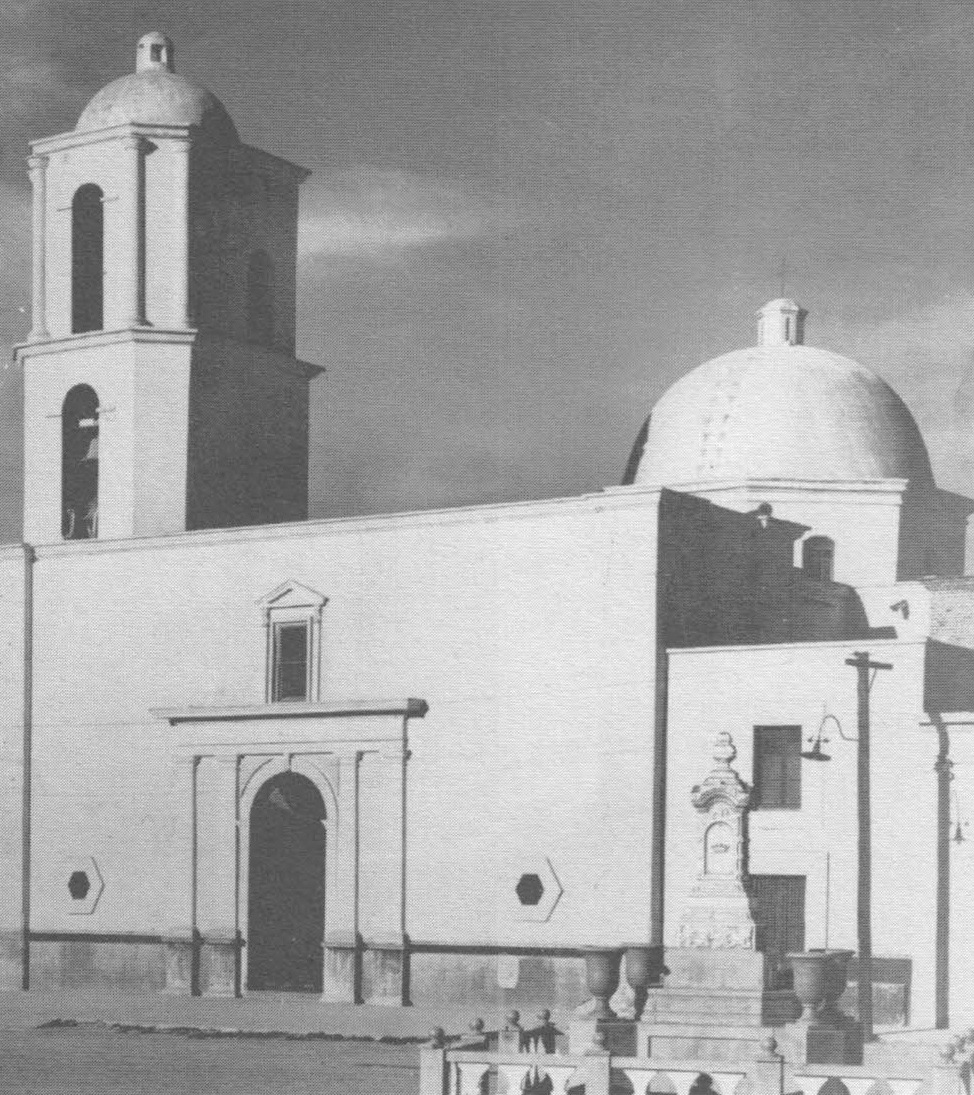
Kino Monument Erected In Magdalena Plaza
Where Dávila Thought The Location of Kino Chapel
Western Ways Photograph 1938
For more information on Kino Monument see March 12, 1996 entry.
Some Previous Attempts to Find Kino's Grave
The Scaffolding of Pioneers
Chapter 6 Introduction
While we were fortunate in finding the remains of Father Kino, we had not been the first persons to make the effort. Long before us, at the beginning of this century [20th] there had been a strong desire on the part of both Mexican and American searchers to locate his burial place and skeleton. Among the first was Herbert E. Bolton who, as already noted, had published his translated version of Father Kino’s diary he found in Mexican archives (Kino 1919). According to elderly informants in Magdalena, Bolton himself had made some of the first efforts even before 1919.
Possibly motivated by Bolton’s try, Sonoran Bishop Juan Navarette had excavated in Magdalena in 1922 and again 1924 for the same purpose, but again to no avail. Subsequently, Frank C. Lockwood, a University of Arizona English professor [and the university’s interim president] and an admirer of Bolton, had followed the latter’s footsteps to Magdalena in 1928 and had excavated both in the local parish church and the so-called “Chapel of San Miguel”.. |30| ....
In 1928, Professor Serapio Davila began to gather information—mainly taken from the oldest informants still living in Magdalena—in an effort to locate the whereabouts of the Chapel of San Francisco Xavier where Father Kino had been buried. In 1930 and the following years, he made excavations in Magdalena in which he discovered part of the foundations—rediscovered afterwards by us--of the later Franciscan-period casa cural [1], or priest's house. He mistook it for one of the older Jesuit constructions but nonetheless suspected the correct location of the church built by Father Campos in 1705-1706, mistakenly believing it to have been Father Kino's chapel of San Francisco Xavier. This miscalculation prevented him from finding what he most desired. (see Fig. 3, B). [Rude sketch of Davila's 1928 excavations drawn by 1935 Woodward based on interview with Davila] ...
Subsequently, other explorations of a more limited nature were undertaken by Professor Eduardo W. Villa, by the writer Ruben Parodi, and by Professor Fernando Pesqueira, all with similar results. |31|
In 1936, Professor Villa tried again, this time joining Dávila in the search. ... Although they were "very warm," they missed the remains. They were very near the foundations of the church built by Father Campos in 1705-1706, but they were fifty meters away from where we eventually found Father Kino ... |32| ...
President Diaz Ordaz's Order: "Find Kino's remains and, once found, identify them and prove their authenticity."
The Hazards of Archaeology
Chapter 7 ...
Professor Jimenez Moreno says in one of his first brief reports to Minister Yáñez, one dated August 20, 1965, that he was appointed on July 20th begin investigations immediately to find the remains of Father Eusebio Francisco Kino.
He writes in this report: "Carrying out the assignment with which you honored me a month ago. . . , with señior Jorge Olvera and others of your collaborators I immediately started research in the National Archives, the National Library, and the Franciscan Archives trying to locate information on this subject. . . ."
The truth is that at the beginning, besides Jiménez Moreno, I was the only one available to conduct research in the national repositories. The "other collaborators" had absented themselves on the grounds that they were already engaged in other important assignments.
According to my notes, just after Jiménez Moreno was commissioned, about the 22nd or 23rd of July, 1965, I started to work in the repositories. I penciled and penned all the information I could find on the subject, and now that I have typed all those rough drafts and hundreds of notes, I can't believe that I did it!
After ten days of being submerged in the archival labyrinths, as I call them, I was officially commissioned at the suggestion of the Director of the Instituto Nacional Antropología e Historia, Dr. Eusebio Davalos Hurtado, to "move immediately to Hermosillo, Sonora, and to Magdalena. . . ." This was July 30, 1965.
Jiménez Moreno had been officially appointed by the Minister under an order given by President Diaz Ordaz: "Find Kino's remains and, once found, identify them and prove their authenticity."
This was the toughest command that Jimenez Moreno had received in his life, his never having been a soldier. He soon found out from a long distance call from Mexico City to Sonora that the burial place of Kino was unknown and that the chapel in which he had been buried had disappeared completely from the vast landscape of the State of Sonora!
Jiménez Moreno's assignment came directly from the Minister and was received the 29th of July and mine on the 30th. I left Mexico City on July 31 and, according to my diary, arrived in Hermosillo on August 2, 1965. |35|
Kino Burial Records - Stolen by Pinart & Microfiche Donated by Dobyns
August 7, 1965 Saturday
Magdalena, Sonora
The Record of Father Kino's Burial: The original burial register containing the notice of death and burial of Father Kino no longer exists in the parish archives of Magdalena. Thanks to Alphonse Pinart's theft, it has come to rest instead - along with other Sonoran church registers - in the Bancroft Library on the campus of the University of California in Berkeley. Many years ago, and at his own expense, American anthropologist and historian Dr. Henry F. Dobyns had photostatic copies made of the original records in the Bancroft Library. He presented these to the Reverend Santos Saenz, pastor of the Magdalena parish. |41|

Kino Burial Record - Copy of Original
It is from one of these excellent photographic copies that I now transcribe the exact wording of the death notice of Father Kino from the Magdalena burial register. |41| I start with the original Spanish script before continuing with the precise English translation:

The correct English version is as follows:
The Year 1711 On the fifteenth of March just before midnight, having received the Holy Sacraments, Father Eusebio Francisco Kino died with great peace and edification in this house and Pueblo of Santa Maria Magdalena at the age of seventy years [sic], having been for nearly twenty-four years missionary of Nuestra Señora de los Dolores, which he himself founded. He toiled without rest in continuous peregrinations and in the reduction and settlement of all this Pimeria. He discovered the Casa Grande, the Gila and Colorado rivers; the Cocomaricopa and Suma nations and the Quicamaspa of the Island, and now resting in the Lord, he is buried in a coffin in this chapel of San Francisco Xavier on the Gospel side where fall the second and third ashlars. He was a German by nationality and of the province to which Bavaria belongs, and before he entered the |42| Pimería he had been missionary and cosmographer in California in the time of Admiral Don Ysidro de Otondo = Agustin de Campos, S.J, [rubric] |43|
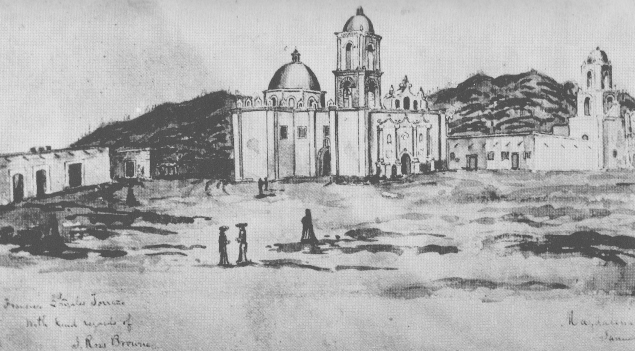
Present Parish Church and Campos Church
Photograph of Watercolor Painting of Magdalena - Figure 4
J. Ross Brown 1864
Present Parish Church and Campos Church Magdalena 1864, J. Ross Browne
August 7, 1965
Magdalena, Sonora and Caborca, Sonora
... While we were inquiring among a group of persons in Magdalena about the possible site where the old chapel of San Francisco Xavier had stood and where Father Kino had been buried, someone told us there was an old photograph in which the chapel could still be seen. We told that person that this item could be very important as it could give us an idea of the location of the old chapel. No one had previously thought of searching for old photographs or drawings of the village, with the possible exceptions of señor Davila or Professor Villa.
We asked if it would be possible to see it. And with the enthusiasm aroused among the people when they learned one more attempt to find the remains of their dear Father Kino, someone immediately went to fetch the photograph from the family they knew to be in possession of it.
Someone else said we were standing on the corner where, more or less, the house of señor Torrario had stood (and from where, as I later learned, J. Ross Browne had made his watercolor sketch).
No one can imagine my joy as I envisioned that our problem had been solved. With this photograph we could study the possible situation of the old chapel by lining it up with some landmark. By studying the contours of the mountains in the background, we could possibly locate the exact place where the chapel had once stood. |44|
The same person who told me about the photograph said it also showed the present church. My joy was unbounded. We had finally solved the problem! Professor Jiménez Moreno would also be very happy on arriving in Magdalena and learning about this fortunate discovery (at this stage of our investigations I had been working alone in Hermosillo and Magdalena).
When the photograph arrived, which was almost instantly (the family who owned it must have lived very near the main plaza of Magdalena), I saw it was not a photograph of the village, but a photograph of a watercolor sketch, one signed by an American artist, J. Ross Browne. The photograph was indeed a very old one (I hold it in front of me as I write these lines). It is now of a yellowish-creamy color, fading away in some parts, but still very clear as a whole. It does show the present parish church, and on the right side of the picture another church of smaller dimensions is to be seen, but one too large to be a chapel (Fig. 4). Sr. Sánchez de la Vega, who was there with the Mayor, don Gerardo Nava, said that the other church was probably the old parish church which had been built by Father Agustín de Campos at the time of Father Kino. He agreed with me it could not be the chapel in which Father Kino had been buried.
Regardless, the discovery of the photograph was excellent because the chapel of San Francisco Xavier might be very near the Campos church.
This small photograph is now a historical jewel. It is only 6 by 10 centimeters, and it is worthwhile to describe it. ... |45|
But the San Francisco Xavier chapel is nowhere to be seen in Browne's watercolor sketch. This led me to believe it might have been a unit within the Campos church, which would make the solution of our problem extremely difficult. But if it were not an integral part of the old church, it could be somewhere nearby.
The watercolor in the photograph is dated on its lower right hand corner: "Magdalena, January 26, 1864," and on the lower left hand corner it is dedicated to "Don Francisco Gonzales Torrario / with kind regards of/ [signed] J. Ross Browne. ...
The person who brought the photograph said I could keep it. Then someone else told me that in a restaurant at the Motel Amelia in Caborca there was another old painting similar to the one in the photograph.
As the van put at our disposal by Governor Encinas was right there, we left immediately for Caborca. We still had plenty of time as it was still before noon.
When we arrived in Caborca, we went directly to the Amelia restaurant. There, Juanita Ruiz, the owner or manager of the restaurant, showed us the painting. This proved to be another great surprise, as the painting turned out to be the original watercolor painted by J. Ross Browne! It was identical to the image in the small photograph we had seen in Magdalena. One could see that the original had been photographed and the print sent by Browne to Sr. Torrario at whose home he had stayed while sojourning in Magdalena, or to María Sainz, who was probably living in Imuris at the time he painted the watercolor. [3] ... |46|
These twin discoveries were the starting point of our good fortune. I now had an opportunity to study the original carefully and to take a good look at all its details. Later on I had the original photographed once again through the courtesy and graciousness of Juanita Ruiz and had two enlargements made, one of them for Professor Jiménez Moreno's files. ...
Persons like Juanita Ruiz, who helped us constantly for almost a year, deserve our greatest gratitude and permanent praise.
In the afternoon, I left for Hermosillo, having received a message that Professor Jiménez Moreno was coming. I arrived in the evening at the Hotel de Anza. ... |47|
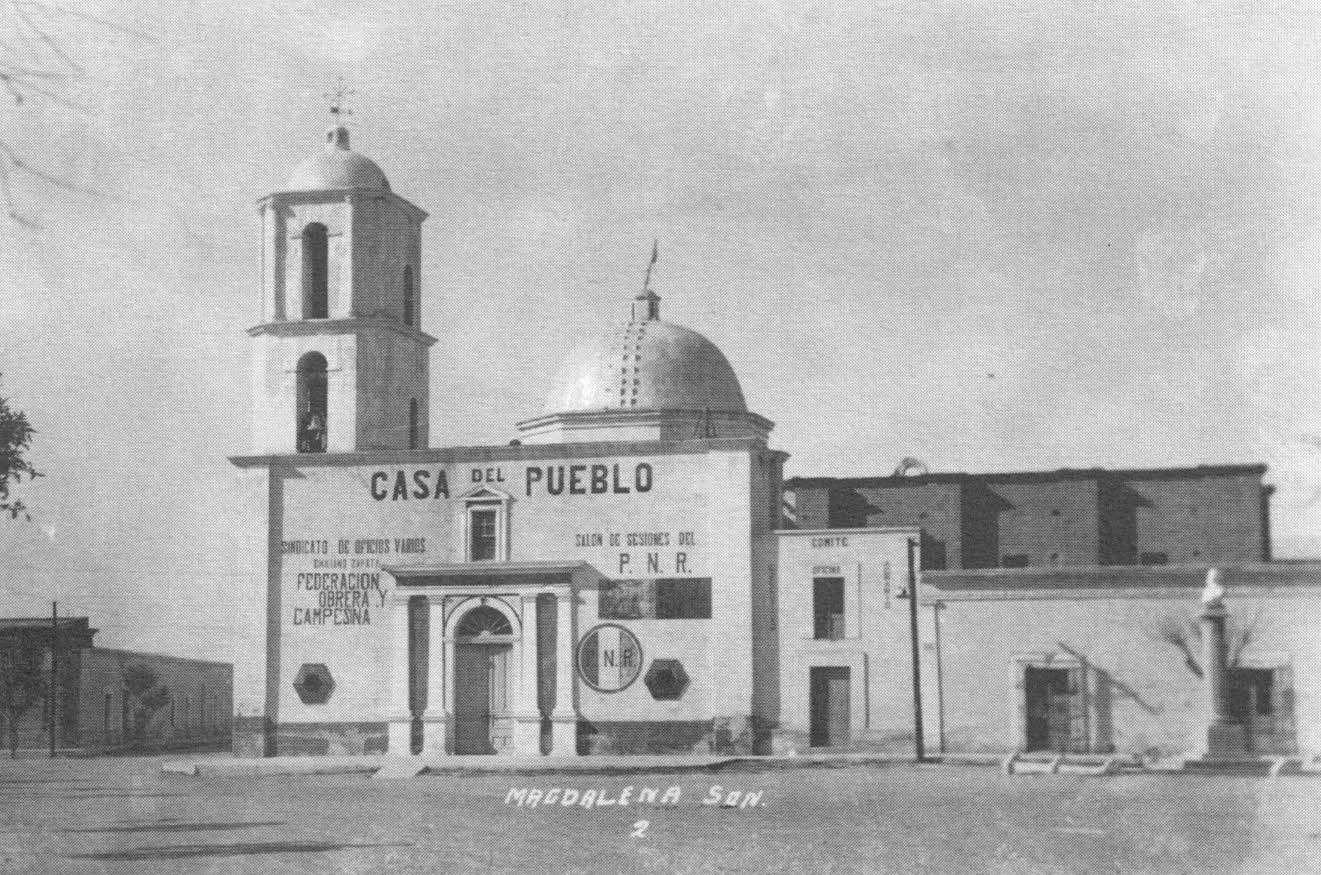
Santa María Magdalena Church Converted Into Community Center During
Sonora Governor Rodolfo Elías Calles' Anticlerical Administration 1931–1935
People of Sonora & Governor Encinas Johnson Champion Search for Kino Grave
Kino "Civilain Hero of Mexico"
August 9, 1965 Monday
Hermosillo, Sonora
This day, and very early, we went back to the cathedral archives to continue our intensive research, but with our burden now greatly lessened by the addition of Father Cruz Acuña who, when we arrived, was already there with the janitor and the keys to the archives. Archbishops in Mexico can be as powerful and demanding as the President.
Among the three of us we managed to gather a considerable amount of information concerning some of the missions of Sonora, their missionaries, and many other interesting things. Of course, each of us focused on our special interests, mine mainly on the architecture, Jimenez Moreno on the ethnohistory of the region, and Father Cruz Acuña on the missionaries themselves.
This same day, our leader (now we were three and we could call him so) managed to obtain an interview with the Governor of the State of Sonora, Lic. Luis Encinas Johnson who, already knowing the President's wishes, offered us all kinds of facilities for the success of our project. He ordered Sonoran governmental authorities to furnish us with anything we should need. For this he called his private secretary, Lic. Aristides Prats, and gave him precise instructions. He then summoned one of his personal drivers and directed him to find the best vehicle for our use. It had to be a vehicle with high clearance and also a very strong one, as the driver, señor Juan de Dios Carreón, would have to take us wherever we wanted to go, even if into the very desert itself. In my lifetime I have had the opportunity to meet several governors, but I have never again met another governor so efficient and so willing to help as Luis Encinas Johnson. He was moreover, a true gentleman.
While we were still talking with him about the great difficulties of the task that had been assigned us, his personal driver—who just a moment before had left as if obeying an order from a superior army officer—returned to report that the vehicle was ready and that since the other van was being repaired, it was the one preferred by the governor for his trips into rough country. Governor Encinas, looking towards Jimenez Moreno, said, "Wonderful, senor Professor don Wigberto Jimenez Moreno! You are served." |49|
When we stepped out of the Government Palace, the vehicle was there with the driver saluting us as if we were General Patton, ready to take us to the cathedral archives. From this day forward until the discovery of Father Kino's remains, and even afterwards, we had at our disposal this wonderful vehicle with its driver, a young and typical sonorense cowboy type, señor Carreón. ...
As for the cooperation on the part of Governor Encinas, one could see it was not only the President's command that motivated him, but that he really knew who Kino was and that he admired and loved him.
During the afternoon we continued our work in the cathedral archives examining hundreds of documents. Now, however, we worked more happily because of the support of the governor and because we were now a three-member team working together in full cooperation.
Professor Arturo Romano Pacheco arrived in Hermosillo while we were still working there. A renowned physical anthropologist in the Instituto Nacional Antropologia e Historia, obtaining his official assignment to our team had been one of the most difficult challenges faced by Professor Jimenez Moreno. It has already been explained how archaeologists, historical researchers, physical anthropologists, and other scholars made themselves unavailable or were made unavailable by their immediate superiors. ... |50|
Professor Romano is a real man of science, and by any scientist, be he or she German, French, or Russian, a project such as this might be regarded as frivolous. Moreover, in Mexico, and perhaps the world over, most scientists tend to be agnostics if not frankly atheists. Professor Romano, for example, after he had begun to work with us in Magdalena, once said to me, "Remember that Kino is not a priest; he is a civilian hero." And I agreed, because for all of us working in the government that was the correct attitude.
The Mexican government has been anticlerical since the days of Benito Juarez—even anti-religious and atheist during the regime of President Calles who subscribed to ideology of the former Soviet Union under Stalin.
But “en el fondo,” at the bottom, as we say in Mexico, Mexico has always tried to follow the ideals of American democracy, and that is why something unusual happened.
For the first time the Mexican government had become interested in unearthing the remains of a priest. But this was chiefly because the United States had recognized the deeds of the extraordinary man, great missionary, and civilizer named Kino. Such a unique cleric could have a respectful place within the framework of a democratic United States, and therefore also within that of Mexico. ...
The anti-clerical stance of Mexico's government and of many of her scientists made the job of Jimenez Moreno—searching for the bones of an unknown priest in a non-existent chapel—even more difficult. Few scientists and technicians were willing to risk their academic standing and the possibility of advancement in an anti-clerical government bureaucracy by becoming involved in such a project. No one knew, moreover, why the President of Mexico had suddenly become so interested in this undertaking. There were those who felt he had a screw loose. ... |52|
Editor Note: Near the bottom of this web page is Jorge Olvera's discussion of the Kino grave discovery as a pioneering effort in historical archaeology.
Father Kino Buried In San Ignacio?
August 14, 1965 Saturday
San Ignacio, Sonora
One of the local researchers were assuring us that the remains of two priests were buried in the nave near the altar, and that one of them could possibly be Father Kino.
|70| ...
I learned more than twenty years later that we had been preceded in our visit to San Ignacio by Sánchez de la Vega, William Wasley, and |72| archaeologist James Ayres, who, like Wasley, was employed by the Arizona State Museum. Sánchez de la Vega, in an effort to locate a rumored container of Kino documents, had supervised excavation inside San Ignacio’s church on January 30, 1965. Ayres and Wasley became part of a group who excavated in the church on January 31, digging a hole beneath the floor of the nave. ... |73|
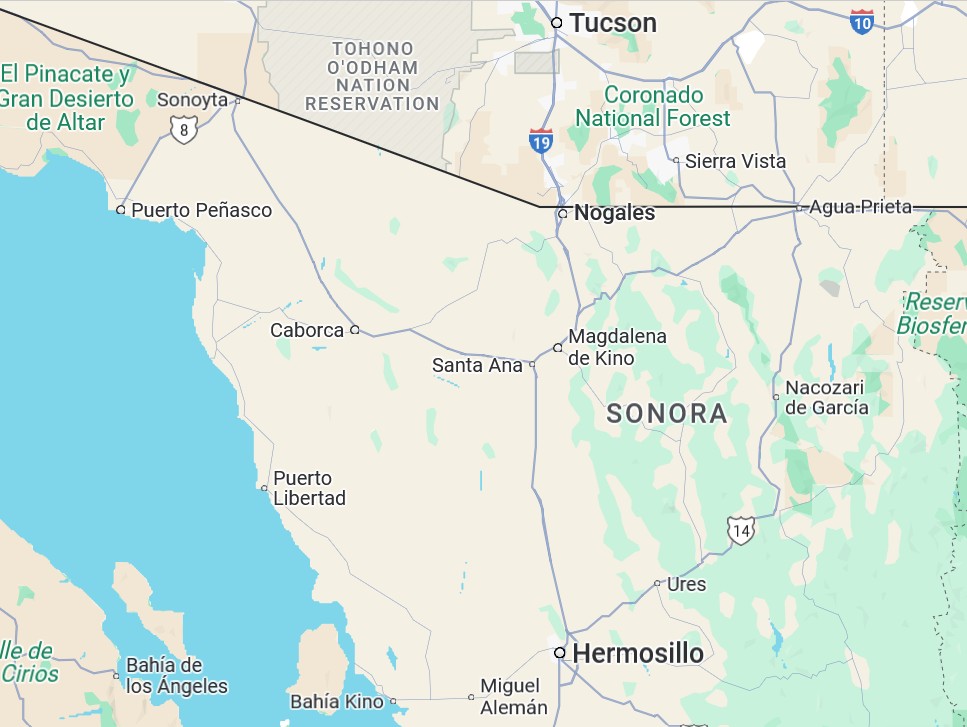
First Research Trip to Tucson
Mission San Xavier del Bac, Arizona Historical Society, University of Arizona
Tucson Is Located 120 Miles North of Magdalena
First Reseach Trip to Tucson; Wasley Joins The Team
August 17, 1965 Tuesday
Tucson, Arizona
In the morning, Professor Jiménez Moreno, Dr. Gillmor, and I went to the book store of Dorothy McNamee [The Overland Bookshop]. Professor Jiménez Moreno bought a large quantity of books, mainly on subjects dealing with the area which we were investigating.
In the afternoon we continued our investigations with the valuable aid of Dr. Gillmor at the Arizona Pioneers' Historical Society. This institution has excellent research facilities and wonderful materials. The people we met in Arizona became great friends who were always very willing to help in any way they could. They were very enthusiastic about our work. Doctors Wasley and Fontana, especially, became interested and lent, and even gave us, photographs and copies of very important documents, etc.
It was also during this occasion, while Professor Romano, Dr. Gillmor, and I were visiting Mission San Xavier, that Professor Jiménez Moreno invited Dr. Wasley to join our team and succeeded in obtaining his permanent collaboration. This was accomplished through an official invitation and request presented to Dr. Raymond H. Thompson, Director of the Arizona State Museum and Head of the Department| 77| of Anthropology of the University of Arizona.
After our work at the Arizona Pioneers’ Historical Society, we left for Magdalena in the evening. .. |78|
To download "Archaeology Notes on the Discovery of Father Eusebio Kino" written by Dr. William W. Wasley in 1966, Click Archaeology Notes on Discovery of Kino by Wasley
Team Leader Jiménez Moreno's Misinterpretation of Browne Painting
August 18, 1965
Magalena, Sonora
In a meeting with Professor Jiménez Moreno he suggested that we start our excavations at the beginning of Calle Francisco I. Madero, basing his opinion on J. Ross Browne's perspective (Fig. 4). Browne's painting seemed to him to show the present church and the old Campos church more-or-less aligned along the present day Calle Madero. Dr. Wasley and I agreed, although from the very start I had a feeling that the Campos church in Browne's painting was nearer to the Palacio Municipal. This was because some low, one story houses seemed to me to be almost at a right angle and perpendicular to the facade of the present church. Perspective, especially in painting, can be misleading. By studying carefully Browne's perspective, one can see that both complexes, that of the present church and that of the Campos church, while initially appearing to be aligned, have different vanishing points.
The illusion that both building complexes are aligned with a common vanishing point, which deceived Jiménez Moreno, results from the fact that the low building shown in the middle of both groups— which has a corner, exposing an angle—is not sufficiently shaded to mark and contrast that corner. This gives the impression, if not carefully examined, of its being a continuous flat wall (see Fig. 4).
The three of us, Professor Jiménez Moreno, Dr. Wasley, and I, agreed to start our excavations as near as possible to the low building that seemed in Browne's painting to stand right next to the present church. From the study we had done in the archives of the Cathedral in Hermosillo about chapels in general, we hypothesized that the San Francisco Xavier chapel could possibly be near, or even within, the old |80| Campos church. With this idea in mind, the three of us determined to open our first trench in front of the present church following Professor Jiménez Moreno's correct suggestion. But there was a slight misunderstanding. When we walked with him to the exact place where he wanted us to start, we were not in front of the church, but in front of the entrance to the “casa cural.” I tried to persuade him to see the perspective in Browne's drawing as I saw it: that the first low building located immediately after the present parish church stood at a right angle to the north corner of the main facade. If so, we should thus start near the front of the main facade. But he insisted strongly on his point of view, and in Mexico, such insistence from a superior is an order.
Partially as a compromise, he explained to Dr. Wasley that these would be our first "trial excavations," and being the first, they could always be rectified. Accordingly, I would start Trench No. 1 immediately beyond the limiting casa cural wall at the beginning of the “baldio” (vacant lot). Dr. Wasley, on the other hand, could start a trench (Trench X) in front of the “casa cural” and nearer the facade of the church (this would be the "trial trench"). This latter trench, at least, was giving us the opportunity to excavate towards the right in the direction in which Dr. Wasley and I thought that the Campos Church could be located.
It has been said that we almost excavated the entire Magdalena plaza in order to find Father Kino's remains. We did, in fact, excavate nearly all of the second of the two plazas of this town, the one formerly dedicated to Francisco I. Madero but which after Davila's and Villa's explorations was dedicated to Father Kino.
The reason for these extensive excavations was the result of two different ways of perceiving and interpreting the perspective used in Browne's 1864 watercolor sketch. As already said, to Professor Jiménez Moreno's eye both churches seemed to have their facades aligned towards the north along Calle Francisco I. Madero. This impression was further strengthened in him by the fact that in the sketch, the Campos church seems smaller, as if obeying the laws of perspective taken from a single point of view and with a single vanishing point. But to me, it appeared the facade of the building in the middle between the two churches was at a right angle to the facade of the present church, turning at a corner showing its side wall aligned with the tower and facade of the Campos church. It looked smaller because it was smaller in comparison to the present church.
Thus there are two different vanishing points in Browne's perspective: |81| one from the present church and another from the Campos church. As I interpreted it, the Campos church would be somewhere near the Palacio Municipal and not towards the end of Calle Francisco I. Madero as Professor Jiménez Moreno had imagined.
Both Dr. Wasley and I started with Trench X with instructions to identify ancient foundations. This first excavation, supervised both by Dr. Wasley and me, was done in accordance with well-established archaeological techniques such that artifacts could be recovered and their positions recorded with horizontal and vertical precision, including their placement in particular natural and human-deposited strata.
During these excavations we recovered a sherd of very interesting 18th-century Japanese porcelain and two or three sherds of Indian-made earthenware pottery. Dr. Wasley, who was really in charge of this trench (I was already starting Trench No. 1), took notes on the find. Although his assignment had not yet been formally confirmed by Dr. Raymond Thompson, Wasley's supervisor, he was quite enthusiastic and very happy to have been incorporated into our team.
These sherds were the first artifacts found, and as we had no supply of bags yet, Dr. Wasley, after taking notes, simply put them in his pocket. I had intended to make a quick drawing, especially of the decorated Japanese sherd, so I asked Dr. Wasley to lend it to me for this purpose. At that very moment, however, we saw Professor Jiménez Moreno coming towards us in a hurried manner. We had been planning to go see him in the parish archives, where he had been working with Father Cruz Acuña. and Dr. Sánchez de la Vega, to tell him the good news of our find, especially about the Japanese sherd which appeared to be late eighteenth century and which indicated we might be near to the old historical center of Magdalena and, perhaps, the Campos church.
Instead, he gave us some bad news. He had just received an urgent communication directly from the Minister of Education in Mexico City telling him that our already-limited time was almost up. The people in Mexico City had learned that on October 4th the Fiesta of San Francisco was going to take place in Magdalena, and that everything would be suspended. Jiménez Moreno had been summoned to Mexico City and had been told that the budget had ended and that We would have to hurry with our excavations. We were also requested to report immediately on what we had found. The only good news was this fragment of Japanese porcelain, and the empty lot, or “baldío,” which was still empty!
Professor Jiménez Moreno congratulated us on our discovery, but |82| in a very diplomatic manner, he told us that henceforth we should bear in mind—always remembering the pressure of this critical situation— that we were not supposed to look for artifacts, but for the remains of Father Kino. We knew, of course, that artifacts could not be overlooked as easily as that. They were indispensable for dating architectural features.
Fearing in advance that a situation such as this might arise, and knowing that a little more than a month from now we would have to suspend our excavations because of the great fiesta of San Francisco which takes place on the first days of October and which fills both plazas and nearby streets with hundreds of booths, we had opted for trenching instead of gridding. Digging on a grid system provides better mapping controls. But exploratory trenching, we knew, could be a much faster method, especially since we were ultimately looking for the foundations of the long lost chapel of San Francisco Xavier. So now, given the bad news Professor Jiménez Moreno had brought us, we could really do no more than search for ancient footings and walls, following them with trenches and employing perpendicular trenches when necessary.
So now, given the bad news Professor Jiménez Moreno had brought us, we could really do no more than search for ancient footings and walls, following them with trenches and employing perpendicular trenches when necessary. |83|
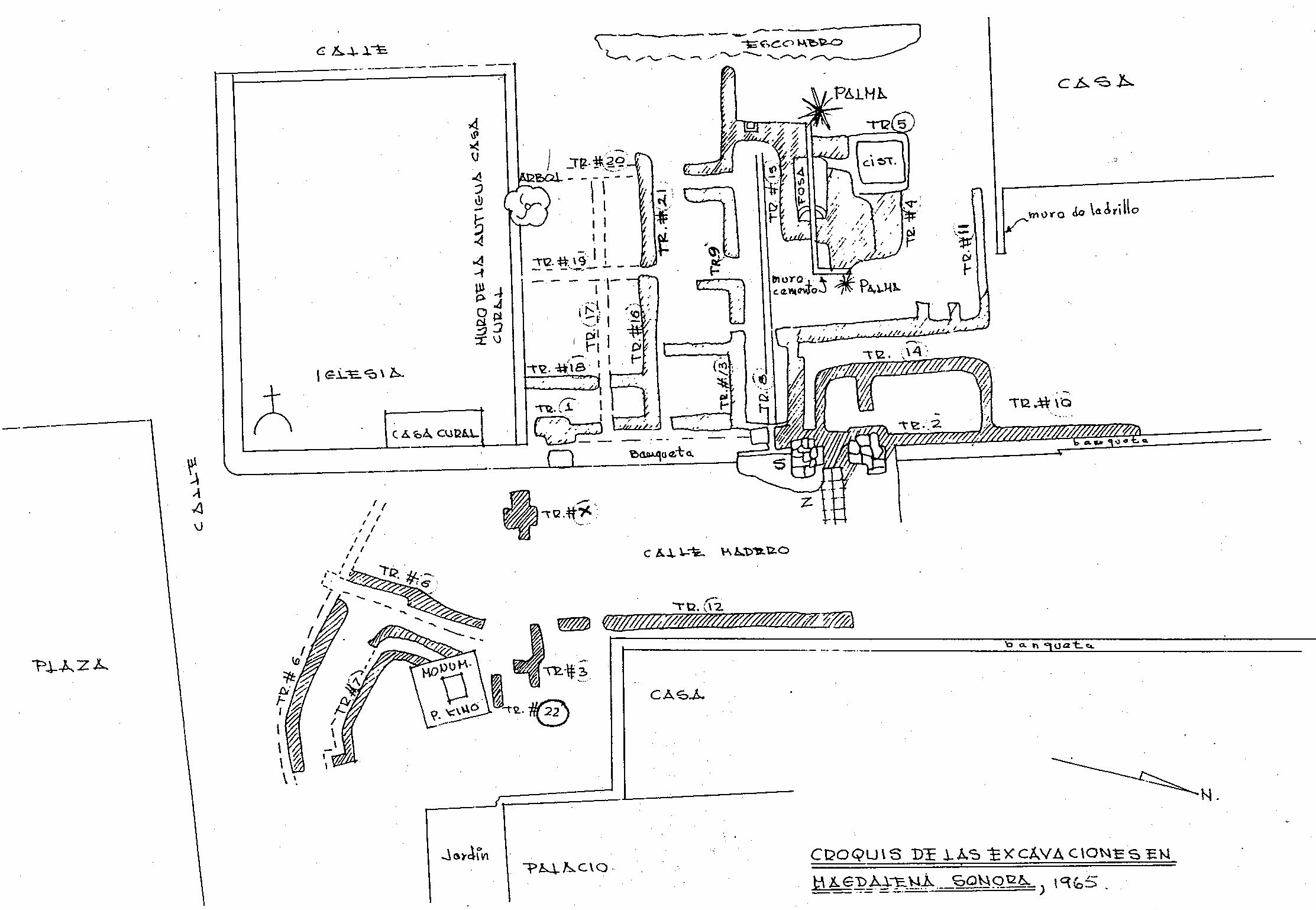
Location Sketch of 1965 Archaeological Excavations Figure 10
The Historic Center of Santa Maria Magdalena, Sonora
Jorge Olvera
Wasley Field Notes Excerpts From August 21, 1965
Kino Discovery Project Status At End of First Field Season - 1965
September 25, 1965 Saturday
Magdalena, Sonora
Cocóspera Mission Ruins, Sonora
It is worthwhile here to include extensive segments for Dr. Wasley’s field notes. They offer the reader a sense of immediacy as well as some understanding of the difficulties under which the work was being carried out. They are also and important record that should preserve in print. ... |140| ... 8/21/65 [Figure 32] .... |141] ...
“NOTE.
1. I am planning to return to Tucson tomorrow, because a) the workmen are not wanting to work, b.) Arq. Jorge Olvera therefore is probably going to go to Tumacacori to interview Judy England, ... |142|
“ 6. Since I will be gone tomorrow for about 2 weeks, I have given some, and I hope to give more, directions before I leave of what avenues ought to be approached. Let me point out, however, that this is no easy matter: we have about as many different sets of previous foundations as there are theories (and there are a great many here in Magdalena) as to where the old church was and where the old chapel (in which Kino was buried) ought to be. We have, just for instance, found foundations in every single trench except Trench #3. These are widely separated, in some cases, and in any event we are certainly dealing with more structures than the meager historical record has revealed. The problem of sorting these out, as to period as well as to structure, is almost unbelievably difficult. We lack for the 19th century almost every detail except that the modern church was constructed and finished by 1832, that the town was visited and sketched by Bartlett, J. Ross Browne, and Pinart, and that [Henry Alexander] Crabb's Filibusters were here [sic! They got no farther east than Caborca when all but a boy were killed in 1857]. Beyond that, we know only that the railroad came thru in 1882, and that the present Casa Municipal was constructed ca. 1921. It is the information for the 19th century, basically, that we lack. ”
“ 9/17/65 Left Tucson 8:15 A.M., arrived Magdalena 1:00 P.M. Went to La Fuente for lunch, and found that Mrs. Drum was back in town, doing the cooking there. She knows a man here in town over 100 yrs. of age whom she thinks may know something about the location of the old church. Quien sabe? ”
I found some other notes written by Dr. Wasley on the Kino project that perfectly summarize all that was done before we went into the third and final stages [April 19, 1966 - June 18, 1966] of investigations that lead us to the discover of Father Kino’s remains. There were in an unpublished article of his titled, |143| “Historic Archaeology in the Missions of Pimeria Alta.—Interim Report, November 1, 1965, on the Magdalena Project.
This essay explains the project's background and includes a summary of earlier attempts by both Mexican and American researchers to find Kino's remains. It also tells about people involved in more recent investigations, including himself, Father Charles W. Polzer, S.J., and James E. Ayres, all of whom served mainly as advisers to those, such as members of the Lions Club of Magdalena, who had already been digging at several sites. For the beginning of January, 1965 he mentions our arrival in Tucson to start what he calls the Current Project Report:
“On August 16, 1965, Professors [Wigberto] Jimenez Moreno, Jorge Olvera, and Arturo Romano arrived in Tucson. As official representatives of the Instituto Nacional de Antropologia e Historia, they had been appointed as a committee, by Agustin Yanez, Minister of Education, at the request of President Diaz Ordaz of Mexico, to conduct scientific excavations in Magdalena in order to find the remains of Father Kino. They were in Tucson (1) to continue archival research which they had begun in Mexico City and had furthered in Hermosillo and Magdalena, and (2) to request of the University of Arizona that Wasley be permitted to accompany them back to Magdalena to assist in the excavations as a collaborator, since they felt that they had no one at the Instituto with experience in the historic archaeology of northwestern Mexico. Wasley went to Magdalena on August 18 and stayed through the 21st and part of the 22nd, during which time excavations were conducted in front of the present church and to the north of the present church. Labor was provided by the state government of Sonora. Prof. Jorge Olvera was left in charge of the work, as the other committee members had to return to Mexico City.
The archaeological problem is threefold: (1) to discover and identify the foundation outline of the church built by Father Campos and the chapel of San Francisco Xavier in which Kino was buried, (2) to determine whether these were two distinct structures or a single joined structure (it has not been possible to ascertain this from the documentary sources), and (3) then attempt to locate and, identify Father Kino's remains in the proper area. The Mexican government officials in Mexico City apparently realize that the ultimate goal may be unattainable—which is a very realistic view—and yet they feel the |144| effort ought to be made, scientifically and methodically.
The approach to the problem, as envisioned by the committee from the Instituto, is to eliminate and narrow down possible locations, by adequate excavation wherever necessary, and by documentary evidence wherever possible until the chapel structure is located and identified.
This appears to be a very logical approach, particularly in view of the large number of foundations encountered by the 24 trenches dug during this phase of the operation, none of which can be related so far to a church structure. Before these excavations were backfilled, they were mapped in detail by an architectural draftsman sent from Hermosillo by Governor Encinas”.
On August 26 Prof. Olvera had to return to Mexico City to make a progress report, to raise additional funds for the project, and to continue archival research.
One basis used for deciding where to dig trenches was the series of sketches showing the old church: Bartlett in 1851, J. Ross Browne in 1864, and Pinart in 1879, all of which show the old church in relation to the present church. [6] Yet it is virtually impossible to reconcile what is shown in any one of these sketches with positions shown in either of the other two. Unfortunately, the earliest photograph so far available, taken by George Wharton James about 1890, shows only the present church and not enough of the area around it, [7] but by this time the ruins of the old church had been leveled anyway.
One encouraging aspect of the series of trenches is that a considerable cultural depth below street level was evidenced in most of the trenches. Therefore, the foundations and at least the lowest portions of the walls of the Jesuit church and chapel could still be extant. On September 17, 1965, Wasley rejoined Prof. Olvera in |145| in Magdalena. The Ministry of Tourism in Mexico City had provided $15,000 pesos to continue the current project .... Excavations were not renewed in Magdalena, because the town had already started to make preparations for the annual fiesta of San Francisco Xavier. ....
Instead, two days [21 and 22] were spent at the ruins of the mission of Cocóspera , taking detailed photographs and studying features of architectural construction ... “
|146|
Footnote [6] With the exception of Pinart's sketch, they show the old Campos church hi relation to the present church. I later discovered by superimposing a tracing of Pinart’s sketch on an old photograph taken from the same angle that it actually shows the San Francisco Xavier chapel rather than the Campos church. |145|
Juan Baptista de Anza
Letter 1770
Complaints of Himuris O'odham Against Priest For Closing San Xavier Chapel
The Last Excavation in Search for Father Kino's Remains: 1966
Chapter 12 ....
I actually stayed in Magdalena until the 30th of September of 1965 ... until I was told to stop because in a couple of days the annual fiesta of San Francisco Xaver was to start. The Mayor had given orders to backfill our excavations. |147|
I formally resumed my work on the 13th of April of 1966, but I had continued to do intensive research home in Mexico City. Mainly in the National Library, Department of Manuscripts. … I found one … potentially useful for our project. Its title is … (“Complaints of the natives of S. Ygnacio, La Magdalena and Himuris against the Father Missionary’) … It reads, in part, as follows: “Se cierra la Capilla de San Fco. Xavier: 1770”. (“The Chapel of St. Francis Xavier is closed: 1770”).
“… they requested by God and the King ... that if your Lordship doesn't want their loss and total ruin he should remove the present Father missionary ... because in both pueblos [San Ignacio and Sta. Magdalena] only six or eight masses have been said to them in two years and they are not taught to pray, and that in Santa Magdalena, he has deprived them of the visible veneration of their saint, Francisco Xavier, closing his chapel.” |148| [Letter from Juan Bautista de Anza to Colonel Don Juan de Pineda, Governor and Captain General of Sonora, January 18, 1770]” |148|
Thus we know from this document that the chapel of San Francisco Xavier in Magdalena was in service in 1770, and that this most venerated saint was being worship in it. … |149|
More Tucson Research: Campos Church Walls In State of Collapse - 1736
April 25, 1966 Monday
San Xavier del Bac, Arizona
We arrived at San Xavier del Bac in the evening, on the same day, Monday, April 25, and because it was too late to look at the mission church, we went directly to the library and archives and stared to work with documents. Those pertaining to the Sonoran mission were quickly located, thanks to Father McCarty’s expert organization of the files. We pored over many documents, mainly Franciscan, but also Jesuit, as well as over bibliographical notes, etc. Each of took a bundle of papers and start to work on them. ... |156|
Dr. Wasley’s notes about our visit so San Xavier del Bac and Tucson she futher light on events of April 26:
“April 26, 1966—Tucson—W. W. Wasley.
Jorge Olvera called about 9:00 A.M. to say that he, Jimenez Moreno, Sanchez de la Vega, Don Fernando Pesqueira, Sr. Montano, and Father Kieran McCarty were in Tucson. Jimenez Moreno appeared about 10.30 A.M. in Ray Thompson's office [Thompson was Director of the Arizona State Museum], to request that I be allowed to accompany them to Magdalena to resume work on the Kino project—this afternoon if possible. Not possible. I will go down with Father Kieran tomorrow afternoon and meet them there. Was with the group from about 11:30 until 6:00 P.M. They had been conducting research at San Xavier and the Pioneers' Historical Society since the night before. ... :”|157| ...
The growth of Magdalena is indicated by the fact that about 1799 Magdalena ceased to be the visita, or mission visiting station, of San Ignacio, and became the headquarters church instead.
A document dated 1736 indicates that the walls of the parish church, that built by Father Campos under Kino's supervision, were in a state of collapse. In 1746 it was being called "the old church," even though there was no other to replace it except for Kino's San Xavier chapel, and in 1748 there was a burial beneath the choir loft of. the "old" church. |159|
Kino Chapel (J) & Campos Church (F) Align With Cardinal Compass Points
As Required by Royal Ordinance
The Compass Direction of North Is In Upper Left Corner
(A) Present Parish Church of Magdalena (1832). (B )Father Kino Monument (1937).
(C) Perez Llera's School of Grammar (1833). (D) Campos Casa Cural (1705-1706). (E) Sacristy ?. (F) Campos Church (1705-1706) (G) Raft Campos Tower Foundation.
(H) Former Palacio Municipal (1900). (I) Former Municipal Jail.
(J) Kino Chapel of San Francisco Xavier (1711).
Date When Structure Completed in Parenthesis.
30 Meters (98 Feet) Is Between (A) Present Church (H) and Former Palacio Muncipal
Traza: Kino Chapel And Campos Church Align With Cardinal Compass Points
May 1, 1966 Sunday
Magdalena, Sonora ...
During the afternoon we had another conference, this time with Professor Jiménez Moreno, Father McCarty, Dr. Wasley, and me, to discuss the masonry foundations we found in front of the facade of the present church. These footings appeared to start at the sidewalk in front of the facade of the church and seemed to end near the southwest |168| west column or pillar of the clock tower of the Palacio Municipal.
Father McCarty, who had been investigating a series of documents from the archives of the Colegio de la Santa Cruz de Queretaro, had made a very timely discovery. He had found a document that suggested these foundations could be those for a structure which the Franciscan, Jose Maria Perez Llera, builder of the present church, had erected for a school of higher learning in the spring of 1833. This was months after he had finished the church now in use, one blessed on December 3, 1832.
Perez Llera tells us about the school in his own words:
“ . . . on this occasion I made an offer to the governor that should I happen to get some religious [priests, brothers, or nuns], I would try to establish a chair of [Latin and Greek] Grammar so I could start to train some young people, but I would need some support to this effect. I added three rooms to the house of Magdalena. “
Father McCarty said he thought these foundations did not start from the point situated in front of the facade of the present church, near the north pilaster, where I had begun to dig for them during the first season of excavations in 1965. On the contrary, he suggested they began on the opposite side and near where we were then standing, more-or-less in front of the clock tower of the Palacio Municipal (see Fig. 36). These foundations, on reaching the east side of the Kino Monument, did not continue in a straight line, but made a sharp turn to the right in a direction parallel to the “casa cural” that had been built by Father Juan B. Comellas in the 1870s and was torn down in the mid 1960s. Had they continued in a straight line from the clock tower, as Father McCarty very reasonably observed, their front wall would have ended in front of the main entrance of the church, blocking it. As Father McCarty reminded us, by 1832 the church was already in place.
This document indicating that Father Perez Llera was building a school in the spring of 1833, and that for that purpose he had added ". . . three rooms to the house of Magdalena. . . ," was discovered by Father McCarty at a very opportune time. It was just then that our archaeological excavations had uncovered these enigmatic stone-masonry foundations about which we knew only that they were Franciscan rather than Jesuit in origin.
“Traza” is a design, a draft, an invention, a plan. It is |169| applied to the original layout of a settlement in conformity with its topographic setting and general environment. ... |168| ... Beginning in the 16th century, all settlements, towns and cities in Mexico were planned by Spaniards according to Roman city planning principals” [as incorporated into the Royal Ordinances] ...
When Kino found the Mission of Santa María Magdalena, he was not doing it in a haphazard or idiosyncratic manner. Hew was obeying the Royal Ordinances of Phillip II ... |170| ...
At Magdalena, town planning was not really up to Hippodamian standards, but as a careful study of "traza" reveals, it nevertheless followed the Roman principals of town planning that were well understood by Kino. ...
How did Father Kino choose the site for the establishment of Mission of Santa María Magdalena? He found this mission in 1687 when he first entered the Pimería Alta, accompanied by his superior, Father Visitor Manuel González. Even that he was in the company |172| of the Father Visitor was in compliance with Ordinance Number 7: “.. . these [discoverers] shall go in pairs so they can render mutual aid to one another." . . .
In the choice of sites for settlement, Ordinance Number 40 recommended: "Very high places shall not be chosen, as they are disturbed by the winds and are difficult of access. Choose intermediate sites, provided with free breezes, especially from the north and south. And if it should be next to a mountain range, it should be seen that this will be on its east side or to the west. If for any particular reason a high place should be built, it should be seen that there is no fog. And if a site should be founded and built on a riverside, see that it is laid out on the east side."
Kino seems to have followed these instructions very closely when he founded Magdalena. He chose the east side of the river and situated Magdalena with the sierras flanking it on the east and west. ... is work as a planner is just beginning to be understood, and thanks in large measure to our research begun during our efforts to locate his venerable remains. ... his work as a planner is just beginning to be understood, and thanks in large measure to our research begun during our efforts to locate his venerable remains.
When Kino laid out the settlement of the Mission of Santa María Magdalena, the embryo of the future city, he may not actually have traced the central “plaza” (what in Roman times would have been the forum). Nevertheless, he had it in mind when he sited the first two and most important buildings of that time: the primitive mission church, begun 1705 (later called the Campos church, because Father Campos was its principal builder), and the chapel of San Francisco Xavier, which he also planned but which Father Campos finished and Kino dedicated in 1711.
These two pillars of the Mission of Santa Maria Magdalena, the first two constructions, were laid out along axis, the cardo [north-south] and decumanus [east-west], that generated the beginning of a settlement destined eventually become a city aligned in terms of Roman planning principles. Looking carefully at the map of Magdalena, one can see that the Chapel of Saint Francis Xavier was built perpendicular to the nave of the Campos church and is oriented exactly north-south, where as the Campos |173| church is orientated exactly east-west. It is known that in addition to his other talents, Father Kino was a trained cartographer (see Burrus 1965). It is more than likely that the man known to have brought an astrolabe with him to the Pimeria Alta used a compass for these operations.
In the positioning of these two buildings lies the generating axis for the growth of the present city of Magdalena and its expansion north‑south along the river and east‑west on either side of it (with most extension to the east where it is not blocked by a steep hill). If the Campos church and the San Xavier chapel had been left “in situ” and their outlines fully preserved, one would immediately see that the facade of the Campos church and the nave of the chapel faced the later plaza. Also, our later excavations and the unearthing of the foundations of the Campos church and those of the chapel (see Fig. 37, contour map) revealed that the seeds of the first streets and avenues were already contained in the pod of Kino's plan.
One of the first streets to be traced lies in the space created between the facade of the chapel, which faced due south, and the north side of the nave of the Campos church. Immediately parallel to this small and narrow street which ran east west towards the river, there is now Calle Cucurpe, which runs precisely east west from the river towards a second and smaller plaza a block and a quarter from the ancient buildings and a block from the present main plaza. The next main avenue (only a block away from the main plaza) is Calle Obregón. Thanks to Kino, the entire present city of Magdalena is laid out in a chessboard pattern springing from the two axial streets of Roman urban planning: the cardo [north-south axial street] and the decumanus [east-west axial street].
The atrium of the mission church and chapel later became the main plaza, and had the old buildings survived, the plaza would have been directly in front of them. We can imagine the first huts and dwellings of the neophytes of Magdalena gathered as a fold in front and around the atrium, as in J. Ross Browne's rednition of Cocóspera in 1862 (see Fig. 28).
This initial settlement plan made by Kino and constructed by Father Agustin de Campos was not only the starting point for the future city, but it followed certain fortification principles recommended by the Royal Ordinances. One of those ordinances, Number 133, stated: "Arrange the buildings in such a way that the lodgings can enjoy the breezes of the south and the north, and at the same time function as fortresses. Each house will have its own "corrals" or stock yards.”
In the Kino plan for the settlement, the corrals were located behind the Campos church and the chapel, on the slope, was defended somewhat by the sharp drop in terrain towards the river. |174|
Now that we have located the exact place where the Campos church and the Campos priest's house stood, it is further possible to demonstrate how the facades of the Campos church and house, with the lateral facade of the chapel, formed a great defensive wall that in military terms is called a "curtain" (see Fig. 37, contour map). From the contour map one can discern that both the Campos church and the Chapel of San Francisco Xavier were built on the highest part of the site. Behind then was a slope and sharp drop in the terrain to the river. All these elements helped protect the mission.
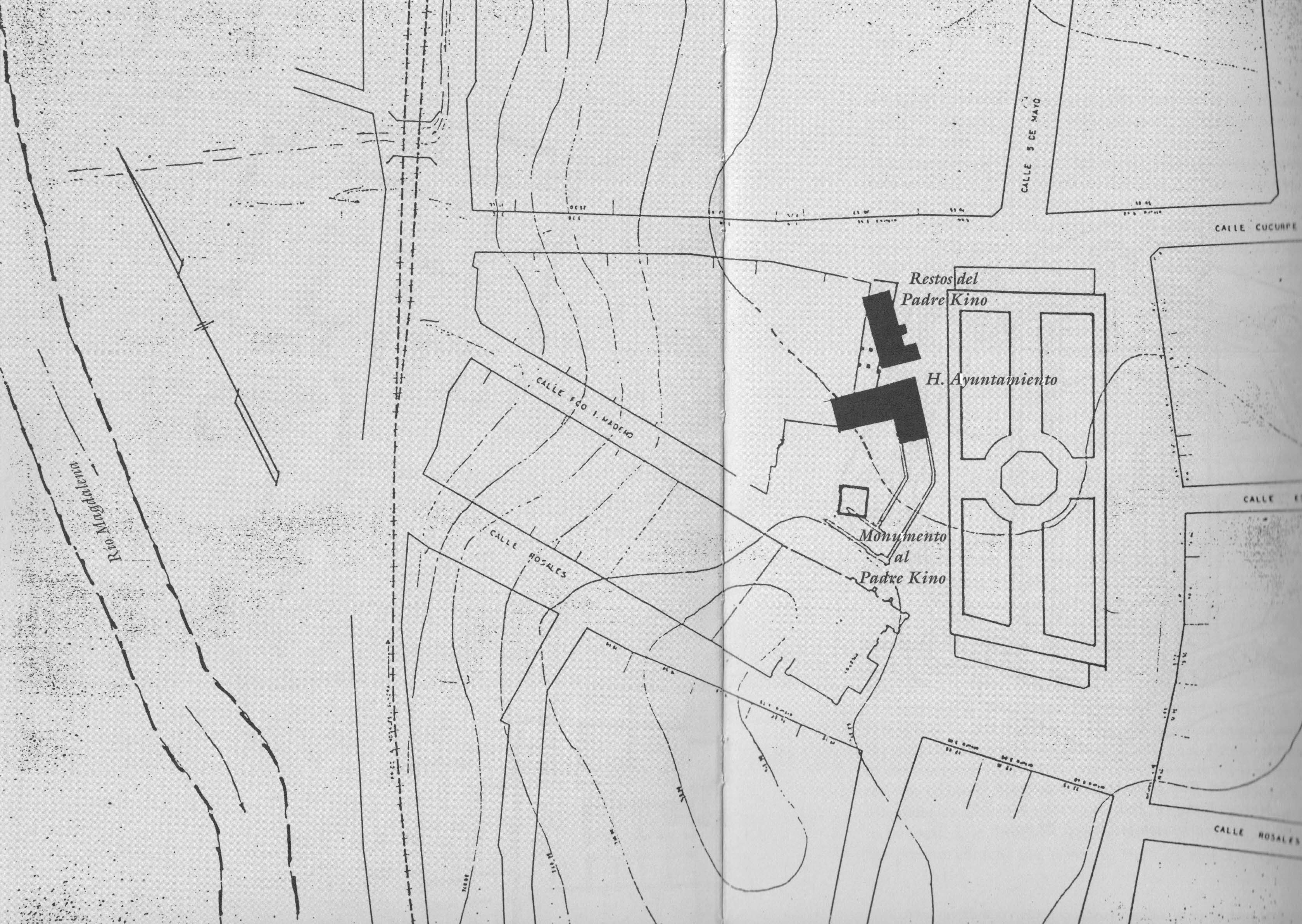
1966 Magdalena Contour Map - Figure 37
Defensive Hill Top Location of Campos Church and Kino Chapel
Traza: Campos Church & Kino Chapel On Defensive Hill Top
Now that we have located the exact place where the Campos church and the Campos priest's house stood, it is further possible to demonstrate how the facades of the Campos church and house, with the lateral facade of the chapel, formed a great defensive wall that in military terms is called a "curtain" (see Fig. 37, contour map). From the contour map one can discern that both the Campos church and the Chapel of San Francisco Xavier were built on the highest part of the site. Behind then was a slope and sharp drop in the terrain to the river. All these elements helped protect the mission.
In 1864, J. Ross Browne (1974: 169, 171) described the topography of Magdalena perfectly: "The town is like all I have seen in Sonora, a parched-up confusion of adobe huts, scattered over the slope of a barren hill. . . ." According to our contour map, Magdalena was indeed laid over a hill as he says in his book. Also, in his watercolor sketch (Fig. 51), one can see the large facade of the Campos house— without a single window—abutted to the tower of the Campos church, both of them forming a "curtain" or defensive wall. One can also see in his sketch how the terrain drops abruptly behind the present church towards the river, as in the contour map.
If we add the lateral facade of the Saint Francis Xavier chapel, which aligns with these other facades, to these large surfaces and elevations, we have almost a continuous and sturdy barrier or rampart protecting the mission from the east side. It is protected from the west by a sharp drop in the natural terrain and by the river.

Magdalena 1864 - Figure 51
J. Ross Browne Watercolor Painting
Present Magdalena Church (left) and Campos Church (right)
Traza: Campos Church's Fortified Tower Staircase Like San Xavier del Bac
There may have been yet another defensive element in both in the Campos church and the chapel, a transverse clerestory window in the upper part of the sanctuary instead of windows in the naves. The latter would have been vulnerable to the attacks by Indians who were in the habit of burning structures that had doors or windows made of wood. This possibility was not considered when we were looking for the re- mains of Father Kino, but it is one I offer now. The early use of the clerestory window as an element of defense has been documented in Central Mexico, in Sombrerete, Zacatecas, by art conservator and historian Gloria Giffords, who discovered one in the Chapel of Guadalupe dating to the beginning of the 17th century, and by me, through archaeological research, in a 16th-century, chapel located in Leon, Guanajuato. Transverse clerestory windows can be traced to Muslim Spain, in Andalucia, perhaps to the 15th century and. before.
In the J. Ross Browne sketch of Magdalena (Fig. 51) one can see that the Campos church had a “terrado” roof (no dome is shown as in the present church). It could have had a high presbytery and a transverse clerestory window. Likewise with the chapel of Saint Francis |175| I kindled this thought, and associating it with the J. Ross Browne sketch of Magdalena, everything seemed to fall into place. In Browne's sketch there is a low building abutted to the tower. It is a long building with no openings. It is perforated only by four well-spaced roof drains or “canales,” as they are called in Arizona, that slant down from near the parapet of the roof. For several reasons, I think this building is the original priest's house of the Campos church. In the first place, the putative priest's house in Browne's sketch seems to be connected directly to the tower. An opening can be seen at the base of the bell tower on its south side, just above the roof of the house. As we know that Magdalena was routinely being attacked by hostile Indians, this well-protected access to the bell tower could have provided immediate refuge and defense for the missionary and his Indian neophytes. They could better defend themselves from up there. Another element of defense is the lack of openings in this building. ...
Another element of defensive fortification in the Campos mission of Santa Maria Magdalena was the fortified staircase that led up to the ... |176| second story of the bell tower, and which can be seen in Browne's sketch. It is identical to one that can be still be observed on the east side of the west tower of Mission San Xavier del Bac, in Tucson, Arizona. It is provided with a defensive parapet handrail built to protect the defenders from projectiles. Fortified staircases like these can still be seen in Spain in the Muslim-Spanish structures of Granada and elsewhere in Andalucia. They are built in such a way that the spring of the stairs is always indirect and built at a sharp right angle turn. This forces anyone attacking to make a sharp and awkward turn as he tries to ascend, and he can be more easily shot from the upper part of the staircase. This is a “mudéjar” architectural feature exported from Spain to the New World. These kinds of staircases are called “escaleras acodadas,” or "elbowed staircases."
For all these reasons I was inclined to think that the foundations in front of us, leading away from what seemed to be a cobblestone pavement, but which could instead be the foundation of the tower of the Campos church, could be those for the priest's house of the original Campos mission, and to which Fr. Perez Llera had added three more rooms.
But where was the chapel of Saint Francis Xavier in which Kino was buried? We still didn't know, but it could possibly be nearby.
If my hypothesis were correct, Kino and Campos, complying with the Royal Ordinances, had fortified the mission from the very beginning. Based on visits we had made to the majority of Kino mission sites, we had come to the conclusion that most of his missions had been built in places that were naturally fortified, such as on the edges of bluffs, cliffs, or ravines. Moreover, the design of his missions must have taken their defense into consideration. This finds corroboration in his diary when he writes of the need to fortify Cocóspera with turrets (Kino 1919: I: 274). The contour map we later had made for Magdalena indicated that the Campos church had also been built on the edge of a bluff.... |177|
Kino Chapel: "Like looking for a needle in a haystack, but first we had to find the haystack!"
May 2, 1966 Monday
Magdalena, Sonora
... among his [Dr. Wasley’s] papers in the archives of the Arizona State Museum Library is a brief manuscript about our project that constitutes an important historical record of our research. Quotations from it are in order here (Wasley 1966):
“In the initial stage of our search in Magdalena, Sonora, for the remains of Father Kino, we had only two leads on which to base our hopes: some meager documentary evidence, a little of which eventually turned out to be misleading, and what little we knew about the architecture of the colonial period in the Pimeria Alta of northern Sonora and southern Arizona. In the final months and weeks of our investigations the relevant documentary evidence was to increase nearly tenfold and provided the archaeologists with valid interpretations of the structures they were uncovering. Long before this point was reached, however, the archaeologists had uncovered dozens of foundations beneath the streets of Magdalena, adjacent to the present church, and even in the jail yard.
At first these remnants of earlier structures served only to confuse the basic archaeological problems and prompted project |178| leader Prof. Wigberto Jimenez Moreno to comment as follows at the end of the project: Our search had been "like looking for a needle in a haystack, but first we had to find the haystack!" There was little hope of finding or identifying Father Kino unless we could first find and positively identify the chapel in which Kino had been buried. This, in a nutshell, was our basic archaeological problem: it cannot be more simply stated. Yet at times the solution appeared elusive if not impossible.”
While I was engaged in trying to interpret these foundations, a gentleman appeared who introduced himself as Senor Adalberto Demara. He said he was 37 years old and a neighbor of Magdalena. The reason for his visit was to try to help us with information. ... |179|
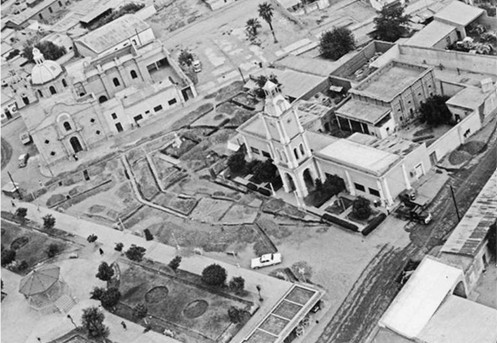
Kino Project Excavations Immediately Before Discovery of Kino Chapel
Kino's Remains & Chapel Found In Corner of Palacio Municipal & Its Clock Tower
Arturo Romano Pacheco Photograph 1966
Wasley Starts Digging Near Palacio Municipal
May 10, 1966 Tuesday
Magdalena, Sonora
Dr. Wasley returned to Magdalena this afternoon. He had been absent since the 3rd of this month to attend the annual meeting of the Society for American Archaeology. His notes covering this period are illuminating:
“While I was gone, excavations were continued in the area between the church and the Palacio Municipal. Excavations |194| were also completed under the choir [loft] in the church and in the north wall of the baptistery from the side of the Notaria [office], where Sr. Ruiz of the fabulous needles had said Kino was buried. When Kino didn't show up here, this character took off quietly and hasn't been seen or heard from since. May 10, 1966. Returned to Magdalena in the afternoon. I am trying to push work in the area of the Presidencia, which has not been previously explored, and Jiménez Moreno is trying to push work in the area of the “puestos de Articulos Religiosos” [shops where religious goods are sold], which turned up only a vast amount of much disturbed earth last year."
Dr. Wasley was now convinced, as I had been from the beginning (but not yet Jiménez Moreno), that the Campos church in J. Ross Browne's watercolor sketch of Magdalena, because of two different vanishing points in his perspective, had been located to the northeast of the facade of the present church and not to the northwest as our team leader thought. This is the why Dr. Wasley wanted to explore the area of the “Presidencia” (Palacio Municipal). I was very happy with his decision, for Professor Jimenez Moreno had been constantly intensifying efforts in front of the parish church and northwest of it around the vacant lot.
Dr. Wasley's decision was an excellent one, and it was on this same day when, conscious of the fact we were running out of time (we were receiving more bad news from Mexico City), he decided, as he told me as we stood in front of the Palacio Municipal, to strip that area in order to accelerate matters to see if, at the very least, we could find the foundations of the Campos church. He also believed that the chapel in which Kino had been buried was likely to be near them. ... |195|
Editor Note: Wasley's reference to "Sr. Ruiz of the fabulous needles" is Santiago Ruiz, a dowser or "zahurino" who travelled from Tucson. Jimenez Moreno, over the objections of other team members and parish priest Santos Saenz, permitted Ruiz to use divining rods in a free attempt to find Kino's remains in present parish church. Jimenez Moreno rationalized the used of Ruiz' services in that he may have knowledge of popular traditions about the location of Kino's grave site. See disuccion in the entry for Sunday, May 1, 1966.
Old Drawings Sent By Cronistas In United States Indicates Kino Chapel Near Palacio Municipal
To the Grand Finale
Chapter 13
May 11, 1966 Wednesday
Magdalena, Sonora
Today I began to act on an idea I had been musing over. A photographic reproduction of an 1879 pencil drawing by Alphonse Pinart shows the ruins of a religious building in the foreground with the front view of the present church and “casa cural” in the background. The ruins in the drawing indicate a rather small bell tower and part of a wall which for the most part has collapsed. This ruined wall has some kind of opening or entrance. To me, this sketch represented the old chapel of San Francisco Xavier and not the Campos church, as some persons were prone to think. I will explain what I did to confirm my hypothesis.
Only a few days ago, I had received from some new and wonderful friends in Tucson, Arizona, Byron and Jane Ivancovich, and from George Eckhart, two excellent photographic reproductions of drawings made by early travellers to Magdalena, Alphonse Pinart and Henry Cheever Pratt (see Figs. 50 and 61). The Ivancoviches had been promoting knowledge about Father Kino in many ways, and it was at their home that I met Father Charles W. Polzer, S.J., who was very enthusiastic concerning Kino and with whom I later made a special trip to Cocóspera to photograph what was left of its ruins.
The reproduction sent by the Ivancoviches had been especially requested by them for me from the John Carter Brown Library of Brown University in Providence, Rhode Island. It was of a pencil sketch of Magdalena, one that had been the basis for an engraving of Magdalena that appeared in John Russell Bartlett's published version of his mid-19th century travels (Bartlett 1854: I: opp. 430). The |200| original drawing was done in 1851 by Pratt, an artist travelling with Bartlett. [1]
Pratt's wonderful panoramic view of Magdalena revealed two things:
1) The center of Magdalena, that is, the original “traza” with the Campos church seen on the left of the present church, was fortified against Indian attack. A high wall can be seen enclosing the compound, just as Tubutama had once been fortified by a wall that enclosed it.
2) The second and most important thing revealed by the drawing was the certainty that the Campos church was located to the right of the facade of the present church; that is, to its northeast rather than to its northwest as Professor Jimenez Moreno had thought. In Pratt's sketch, which drawn from the side opposite to that of J. Ross Browne's watercolor, it is located to the left and towards where the Palacio Municipal stood in 1966.
This told us we should dig towards the Palacio Municipal. The other photographic print, sent to me by my good friend George Eckhart, serendipitously arrived almost at the same time as the first one. It, too, was of a pencil sketch, this one drawn in 1879 by Alphonse Pinart of the present Magdalena church and of some ruins in the foreground.
I showed the sketch by Pratt to Dr. Wasley, and after seeing it he completely agreed with me on the possible location of the Campos church. He thought, however, it would be wise to cross the river to the other bank of Magdalena. This would be the day-after-tomorrow because he had already started to strip the area in front of the Palacio Municipal and he had to be there to direct the stripping. Once on the west side of the river, we would look for the spot from where Pratt had drawn his panoramic view of Magdalena. ... |201|
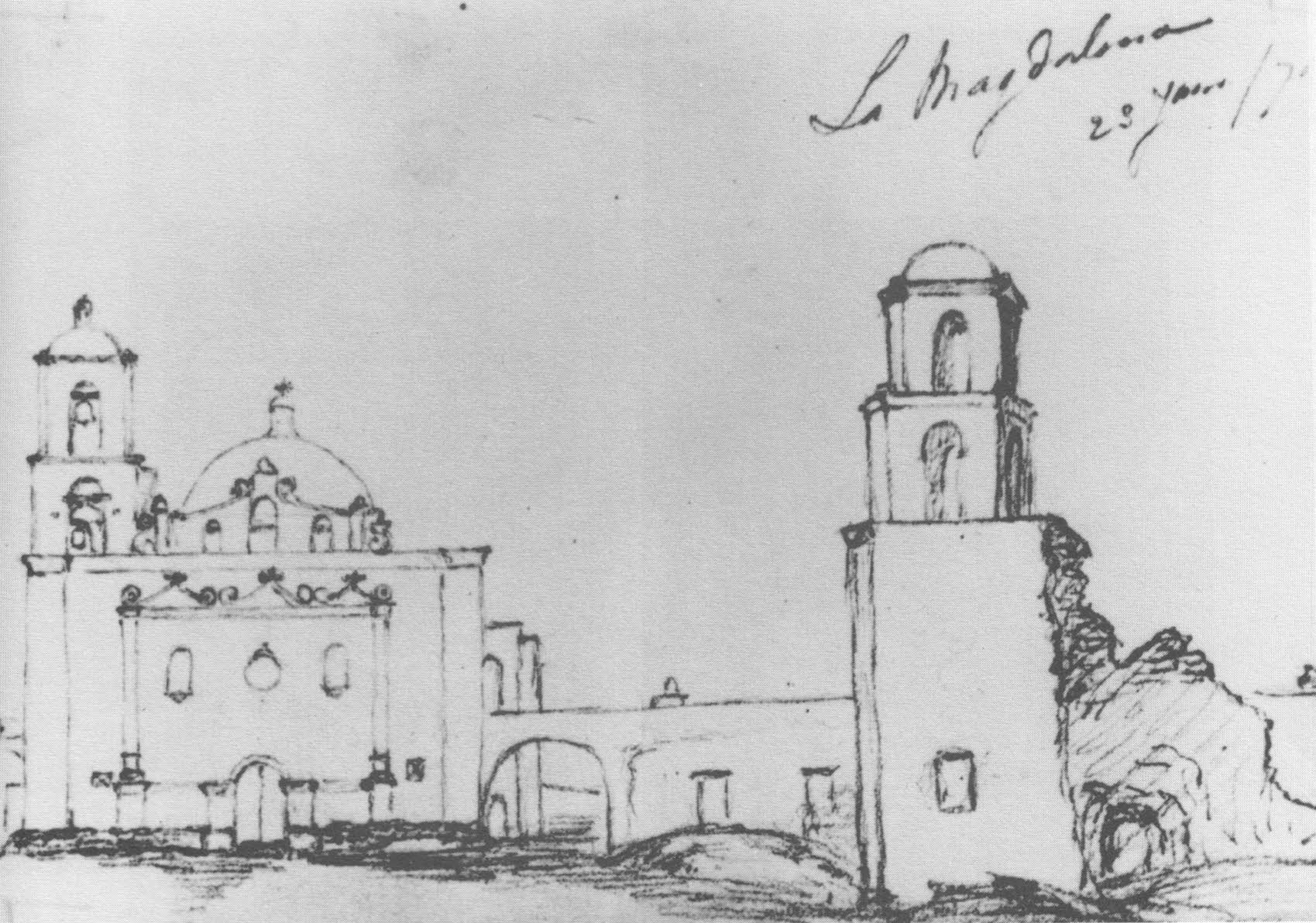
Present Church (left), Kino's Chapel (right) - Figure 50
Dirt Mound left of Kino Chapel is Remnant of Campos Church
Artist Alphonse Pinart
Magdalena 1879
Pinart Drawing (1879) Clears Up Deceptive Perspective of Browne Painting
May 11, 1966 Wednesday
Magdalena, Sonora
The photograph with the reproduction of the Alphonse Pinart pencil sketch of Magdalena was also very interesting, and I had been carefully studying it. It represented the present church of Magdalena looking full face to the viewer, with its complete facade, bell tower, and “coronamiento” (an almost baroque crowning) as well as a great part of its dome and of a considerable part of Father Comellas's “casa cural,” with a large arched entrance, abutting the nave of the church. But in the foreground, towards the right hand of the artist, the ruin of a religious edifice can be seen. Some authors have mistaken it for the Campos church, and when they refer to it, they identify it as such. But I recognized features in the sketch which told me this ruin was not that of the Campos church.
In the first place, in working out the proportions, it becomes clear the bell tower is too small to have been the Campos bell tower. It also lacks the fortified staircase which otherwise is to be seen in J. Ross Browne's 1864 watercolor.
Secondly, what is left in Pinart's sketch of the main entrance to the supposed Campos church faces Father Comellas's casa cural; that is, it is approximately parallel to it. We are seeing its rear, as if we were looking at it from the apse.
In Pinart's drawing, the facade of this ruin doesn't appear to be aligned with that of the present church as it seems to be in J. Ross Browne's visually deceptive perspective, a perspective which not only tricked our team leader, Professor Jiménez Moreno, but many others as well. The confusion resulted from the fact that Browne's sketch has two different vanishing points.
I had been given by someone in Magdalena, whose name I have regretfully forgotten, an old photograph which resulted in something quite amazing. It had been taken from the very spot where Pinart had made his drawing of the present church of Magdalena and of a ruin which turned out to be that of the Kino chapel for which we had been searching. ... |202|
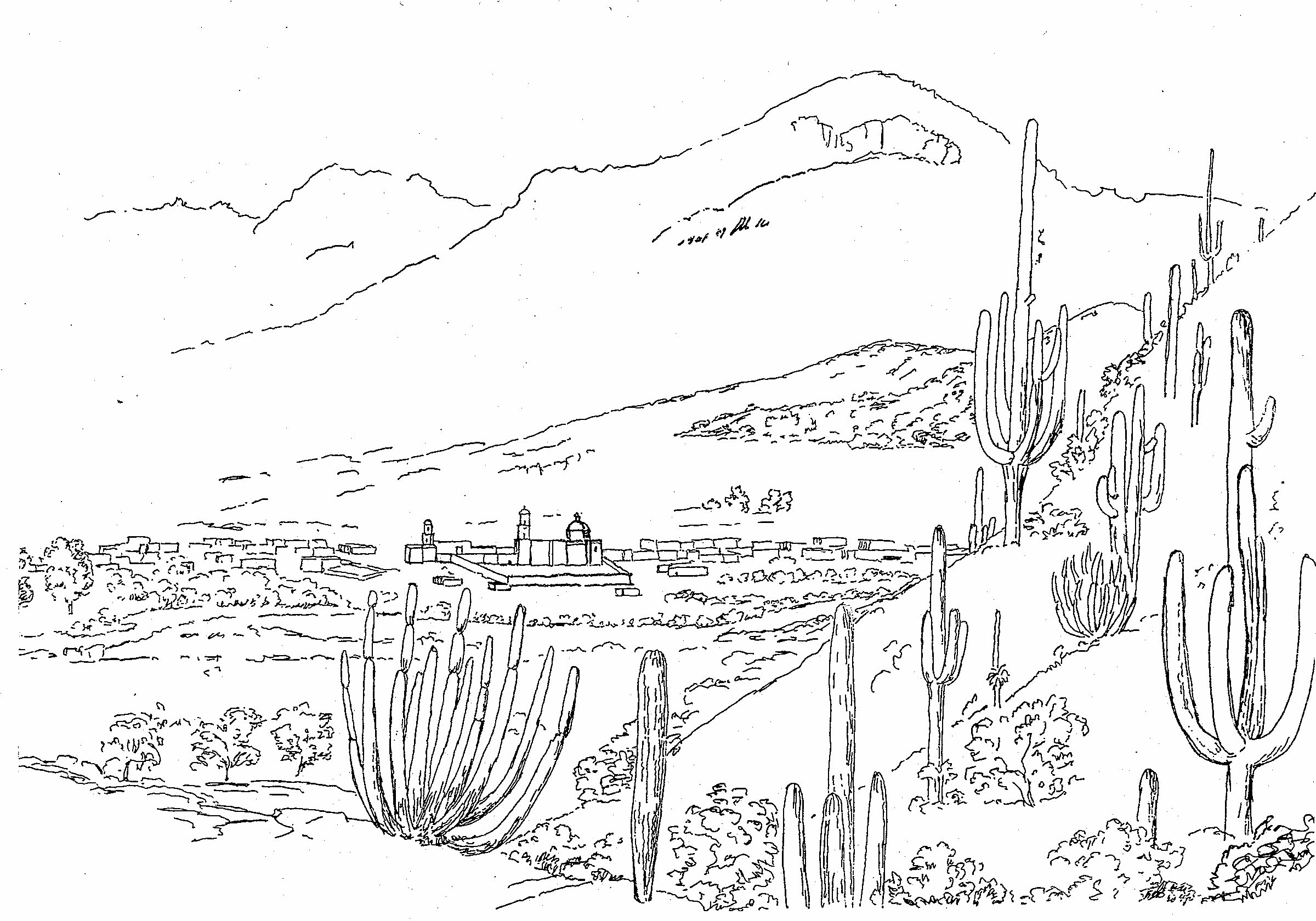
Present Church (right center) and Campos Church (left center) - Figure 61
Henry Cheever Pratt
Magdalena, Sonora 1851
Pratt Drawing (1851) Shows Campos Church Near Present Palacio Municipal
May 12,1966 Thursday
Magdalena, Sonora
First Entry
Early this morning, before the heat rose, Dr. Wasley and I decided to cross the Rio Magdalena to its west side and climb the hill there in search of the place where one of Bartlett's artists, Henry C. Pratt, had drawn his panoramic view of Magdalena (see Fig. 61). We took along the reproduction of his sketch to check the accuracy of the drawing. |202|
We were fortunate to be able to cross the river in Dr. Wasley's van over a good modern bridge. Once on the hill, we guided ourselves by the location of the Magdalena church, and we were able to find the exact place where Pratt had stood when he made his drawing. Even some of the same giant organ pipe cactus and saguaros still seemed to be there.
This experience was an exhilarating one. There, in front of us and with little change, was the town of Magdalena with the present church standing out as in the Pratt sketch. But instead of the old Campos / church, which in the panoramic view of the village is to the left, we now saw a little more in that direction the clock tower of the Palacio Municipal. This was extremely important, for now we knew for sure that the remains of the Campos church would probably be located quite close to the clock tower, and perhaps the foundations of Kino's chapel as well.
The only thing missing from Pratt's drawing of Magdalena was precisely what we were looking for: the chapel. We afterwards found out that its location was indeed right next to the Campos church. Why did Pratt leave out the chapel? Everything else is perfectly clear and in order.
I am unable to explain why Pratt left the chapel out. It also had a little tower that would have stood out clearly next to the Campos church. We know that twenty-eight years after 1851, the year Pratt made his drawing, the chapel still existed. Its ruins, still with the small bell tower but with the nave turned into a heap of earth, are to be seen in Pinart's 1879 sketch. By that time, the Campos church no longer existed and is seen in Pinart's drawing only as a big mound of earth in front of the small bell tower of the Kino chapel. Some informants more than 80 to 85 years old, who had been born in Magdalena, had explained to Jimenez Moreno, Sánchez de la Vega, and Fathers Cruz Acuña and McCarty that when they were small children they used to play on a big mound located in the direction of the southeast corner of the Palacio Municipal.
Dr. Wasley and I returned to the heart of Magdalena convinced that while the Kino chapel didn't appear in the Pratt sketch, the Campos church had stood very near the present clock tower. Wasley had "hit the nail on the head," or “dio en el elavo,” as we say in Spanish, when on his return to Magdalena he had immediately decided to strip the area in front of the Palacio Municipal.
As soon as I returned to the excavations, I also directed my workers to advance the digging from where we were located a few meters away from the clock tower toward the north, and to follow the odd looking foundations that the Fr. Pérez Llera had built for his school. |203|
Pérez Llera had started from the old Campos "casa cural," which he called the casa de Magdalena ("house of Magdalena"). He had literally written that he had "added three rooms to the house of Magdalena," to none other than what had been Father Campos's house and that of priests who followed him. I suspected that those strange foundations that turned at an angle of about 20 degrees towards the clock tower could lead us to the foundations of the Campos church because the area that looked like a cobblestone space could be the foundations of the Campos church or of its bell tower.
This cobblestone space had been a mystery. Because the foundations we had uncovered for the school built by Pérez Llera seemed to end precisely and mysteriously where the cobblestone space began, my initial hypothesis was that the cobblestone area was a kind of minor plaza built for some unknown reason by the Franciscans. Very soon, however, that hypothesis was destroyed by new evidence, the evidence from the drawing by Alphonse Pinart.
If this were so, we could now say we had finally found the long lost chapel for which we had been so earnestly searching. But this new hypothesis had to be proven.
How did I find out that Pinart's drawing was of the Kino chapel and not the ruins of the old Campos church? This should be explained in some detail. ... |204|

Present Magdalena Church (left) with Comellas Casa Cural and Kino Chapel (right)
Alphonse Pinart Drawing - 1879 Figure 50
Superimposition: Pinart Drawing Shows Kino Chapel From The Back
On the day I received the Pinart sketch from George Eckhart, I started to study it very carefully. For there in the drawing, looking me in the eye, as it were, was the present church of Magdalena. And to the right in the sketch were the ruins of an old religious edifice with a big mound of earth in front of a rather small tower. By studying the perspective, it was possible to see that the proportions of this tower compared with those of the present church were not those of a large, massive tower. The J. Ross Browne watercolor, on the other hand, shows the Campos church with a tower of more or less large proportions.
Then I noticed several other differences between the Campos church as shown in Browne's watercolor and the church and bell tower in the Pinart sketch. The Pinart drawing shows part of a facade which had not yet collapsed. Its small arched entrance is still to be seen. However, while the facade seems to be abutted to the tower, as it really was, we are not seeing the front of it, but the back, as indicated by the shading in the drawing. Pinart was looking at the ruins of this religious structure from where the apse had been; that is, from the back. This tells us that the facade of this building was almost facing Father Comella's "casa cural," and not the Magdalena plaza. The Campos |204| church in Browne's watercolor, on the other hand, is clearly facing the plaza.
Another important difference in these two sketches is that while the bell tower of the Campos church was provided with a very large defensive staircase, one similar to that seen today on the west bell tower of Mission San Xavier del Bac, the bell tower in Pinart's drawing has no such staircase. This means that the belfry in the latter tower was most probably reached by a spiral staircase fashioned out of mesquite. ... |205|
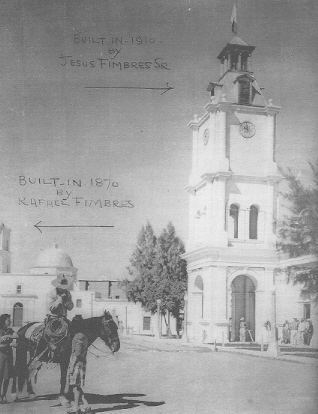
Post 1937 Photograph of Magdalena by Unknown Photographer Figure 60
Present Magdalena Church (left) and Former City Hall (right)
Superimposition: Matching Walled-in Arch of Present Church Office with Post 1937 Photograph and Pinart Drawing
Superimposition: Old Photograph Taken From Same Vantage Point As Pinart Drawing
As if to confirm my hypothesis, I had been given an excellent old photograph that showed part of the facade of the present church as well as the clock tower of the Palacio Municipal (see Fig. 62). Amazingly, the photograph had been taken almost from the exact place, angle, and distance where Pinart had situated himself when he made his drawing. The details of the facade of the 1832 church are so well drawn that it would be possible in the future to restore it precisely to its original form.
The old photograph showed the place, later walled in with another story added to it (see Fig. 63), where the arched entrance to the casa cural used to be. It also showed the two doors to the right of where the large and imposing arch had been.
There was only one thing to do, and that was to superimpose the Pinart drawing on the photograph. In this new drawing, a mounted cowboy lighting his cigarette and two young girls are in the foreground (Fig. 64). The photograph is undated, but it was probably taken after 1937 when, according to an informant interviewed by Professor Jimenez Moreno, the local Monument to Father Kino was erected. In spite of its hazy appearance, this monument can be seen in the photograph behind the horse's head and in the distance in front of the "casa cural." Also, the facade of the present church is here the same as in another photograph taken by Western Ways of Tucson, Arizona, and dated 1938 (see Fig. 56). In this photo, the Kino monument is seen in the foreground.
The year 1937, given by Professor Jimenez Moreno's local informant as the date when the monument was built, is probably correct. Professor Eduardo W. Villa (1937: 130-131), explaining how he and Serapio Davila excavated in Magdalena in 1936 to try to find Father Kino's remains, wrote that when they thought they had finally found the foundations of the chapel in which Father Kino had been buried (which were actually the foundations of Father Pérez Llera's school), they conceived the idea of erecting a monument to Father Kino right there. Later in 1936, Professor Villa began to work on this project. |205| The monument was there in 1938 when Western Ways took the photograph, so one can conclude it was erected in 1937. ... |206|
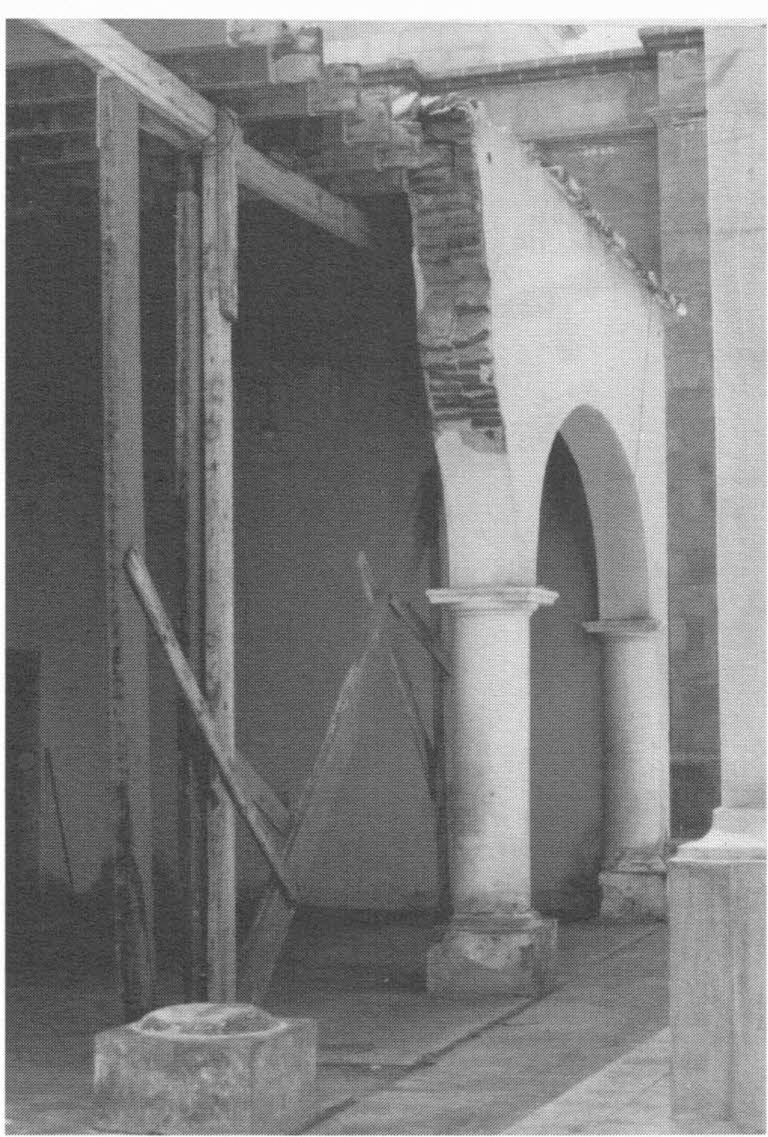
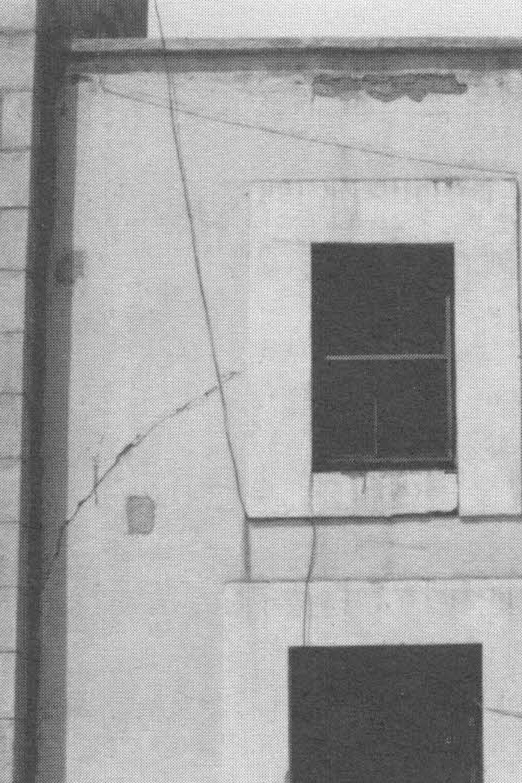
Registration Points: Arch of Comellas' Casa Cural Built Around 1875
Left Photograph: Beginning of Demolition of Arch Figure 63
Right Photograph: Before Demolition, Walled-In Arch Outlined By Flaking Plaster of Front Wall of Present Church's Office - Left of Second Story Window Figure 34
Jorge Olvera Photographer 1966
Superimposition: Matching Walled-in Arch of Present Church Office with Post 1937 Photograph and Pinart Drawing
Using tracing paper, I tried several superimpositions using excellent registration points that nearly matched in Pinart's drawing and in the photograph. These points were in the arched entrance to Father Comellas's "casa cural." The photograph indicated the same entrance, but by 1938 it had been walled in and converted into a small building raised a little higher over the arch. The outline of this arch could still be seen in 1966 on the face of the building, which later became the office for the parish notary. The curvature of the arch could clearly be seen in the wall where the plaster had flaked off because of differential settlement of the lower walled-in portion. I took a good photograph of this architectural witness (Fig. 63).
Dr. Wasley had noticed the existence of this walled-in arch in 1965, for he included it in a quick sketch he had made in his field notes of the present church and the casa cural of Father Comellas (Wasley 1966). His drawing, which he labelled "iglesia actual de Santa Maria Magdalena," shows the facade of the present church in a very schematic way. Next to it, he drew the new small building where, according to the Pinart sketch, the arched entrance to the Comellas casa cural used to be, and wrote above it "oficina de la curia." He also drew the arch, cut in half by the window of the upper story, as well as the complete casa cural up to its second entrance and final wall. He wrote above it: "Casa cural de Comellas." Finally, above the last wall of the second entrance, he wrote, "El muro de la casa cural de J. Ross Browne" or, "the wall of the "casa cural" depicted by J. Ross Browne." Here, however, he was still influenced by Jimenez Moreno's mistaken interpretation of the Browne watercolor. He believed with Jimenez Moreno that this wall was an aligned continuation of the facade of the church when, in reality, it moved away from the church in a perpendicular fashion, as our later excavations of its foundations revealed.
During the final days of the project, and after we had oriented ourselves with Henry C. Pratt's panoramic view of Magdalena that showed us the Campos church used to be located near the Palacio Municipal, Dr. Wasley began to agree with me in everything. By superimposing the 1879 Pinart sketch on the post-1937 photograph, I would try to convince my other colleagues, Sr. Sánchez de la Vega, Father Cruz Acuña, and Cornrado Gallegos. Professor Jiménez Moreno remained reluctant to accept the idea that the ruins in Pinart's sketch could be those of the Kino chapel. He continued to be convinced that they represented the ruins of the Campos church. |206|

Jorge Olvera's Composite Sketch Tracing - 1966 Figure 64
1938 Photo of Magdalena (Figure 63) overlayed by 1879 Pinart Drawing (Figure 50) Reveals Location of Kino Chapel Foundations Within Inches of City Hall Clock Tower Present Church (left) and Kino Chapel (center) and City Hall (right)
Superimposition: Overlaying Pinart Drawing on Post 1937 Photograph Locates Kino Chapel Near Palacio Municipal
Romano Takes Over Direction of Excavations From Jiménez
I finally found the correct superimposition of drawing and photo (Figs. 50, 62, 64). This overlay of the two images worked perfectly, and it told me where we would finally find Father Kino's grave site. This was right next to the clock tower of the Palacio Municipal, and its foundations would probably be located near its northeast corner. Digging in that direction, we would see if they still existed.
Professor Romano returned from Mexico City during these last exciting days. Finally and abruptly, the tremendously entangled and complicated parts of the puzzle were coming together. It had not been easy for Professor Jimenez Moreno to arrange for Professor Romano's return to Magdalena. ...
As we had approached the Palacio Municipal with our excavations, we had hit a Franciscan cemetery and had begun to find skeletal remains scattered everywhere. Which of these could be Kino? It was like looking for the proverbial needle in a haystack.
Just at that moment of despair and confusion in our research efforts, Francisco Gonzalez de Cossio, a famous Mexican historian who specialized in the viceregal history of northern New Spain, made things worse by publishing an article in one of the leading newspapers of Mexico City under the headline: THE REMAINS OF FATHER KINO WILL NEVER BE FOUND. And in the article he pretended to demonstrate why.
This was the atmosphere that prevailed in Mexico City with respect to our project, and probably in Sonora and Arizona as well. The Minister, Agustín Yañez, was now nervous and quite angry. Consequently, all serious researchers, and especially those in the National Institute of Anthropology and History, thought ours was indeed “un proyecto descabellado”, a crazy project. No one who thought himself worthy of being regarded as a serious researcher or scientist would be willing to expose himself or herself to ridicule. Given this atmosphere, not even the Minister of Education was able to recruit someone daft enough to go to Magdalena.
This is why Jimenez Moreno's great perseverance and faith are to be admired. He pleaded with the Minister for a physical anthropologist, and it would be better if it were Romano. Romano had already |207| been in Magdalena and made two important contributions to the project: the explorations of the "Proctor Chapel" and at San Ignacio. This work had eliminated two sites favored by everyone for the Kino burial place.
But Jiménez Moreno’s pleading didn’t work. He only received a ministerial scolding. Nevertheless, he remained undiscouraged. He made a final effort, this time bringing the matter before the President [of Mexico] himself. He finally obtained what he desired and needed, the services of Professor Romano.
So Professor Romano was among us again. And fine gentlemen that he is, he accepted not because it was a presidential request, but because he was a friend of Jiménez Moreno and would not let his friend down.
As soon as he arrived in Magdalena, Romano [INAH Mexico physical anthropologist Arturo Romano Pacheco] very discretely asked me if we had any idea where the long lost chapel and tomb of Father Kino would be.
I told him that Dr. Wasley did, in fact, have a general idea where the chapel foundations could be found, and I believe I told him about our experiences with the Magdalena sketches made by J. Ross Browne and Henry Pratt. I told him that Wasley and I had been happy to have our suspicions confirmed by finding, very near the southeast corner of the Palacio Municipal, a Jesuit foundation made of boulder held together with mud and clay mortar. I seem to recall I also told him that Professor Jimenez Moreno differed with us about the location of the chapel foundations, that the professor continued to believe they were either in the direction of the area around the vacant lot or in the jail yard.
Romano must also have spoken with Dr. Wasley and received confirmation of what I had said. He took my suggestion and started to direct excavation towards the area in front of the clock tower of the Palacio Municipal. ... [208]
Burial Record of Jose Gabriel Vega In Kino Chapel 1837
Prisoners Help With Kino Excavations
May 12, 1966 Monday
Magdalena, Sonora
Second Entry
This was a busy and lucky day. Most of us worked in the Parish Archives, including Professor Jimenez Moreno, Father Cruz Acuña, Sanchez de la Vega, Father Kieran McCarty, and I. Feeling somewhat relieved by what the Pinart sketch had disclosed, I felt more free to help with archival research.
We came upon a revealing document in the Libro de entierros, the book of burials. I don't recall who found it, but it occasioned general happiness among all the team members. The document read: “Entierro de Jose Gabriel Vega: El 27 de junio de 1837, Jose Gabriel Vega de 90 años de edad . . . su cuerpo fue sepultado enfrente del nicho de Senor San Francisco en la Capilla Vieja” ("Burial of Jose Gabriel Vega: June 27, 1837, Jose Gabriel Vega, 90 years of age. . . his body was buried in front of the niche of Señor San Francisco in the Old Chapel").
This document, signed by Franciscan Fr. Rafael Diaz, told us that the chapel of San Francisco Xavier remained in use in 1837, at least for burials, and that it contained a niche for an image of Saint Francis Xavier.
Professor Jiménez Moreno suggested that we start excavation in the municipal jail yard at the same time as others continued that Dr. Wasley and I were carrying out in front of the clock tower of the Palacio Municipal. ...
Almost everybody took part in the excavations within the jail and jail yard, even the prisoners themselves, some of whom had been convicted of murder. They seemed quite happy to be included in out project. |209| We soon became aware that they were turning out to be the best diggers. The dug with great enthusiasm and gusto, especially near the walls, ...
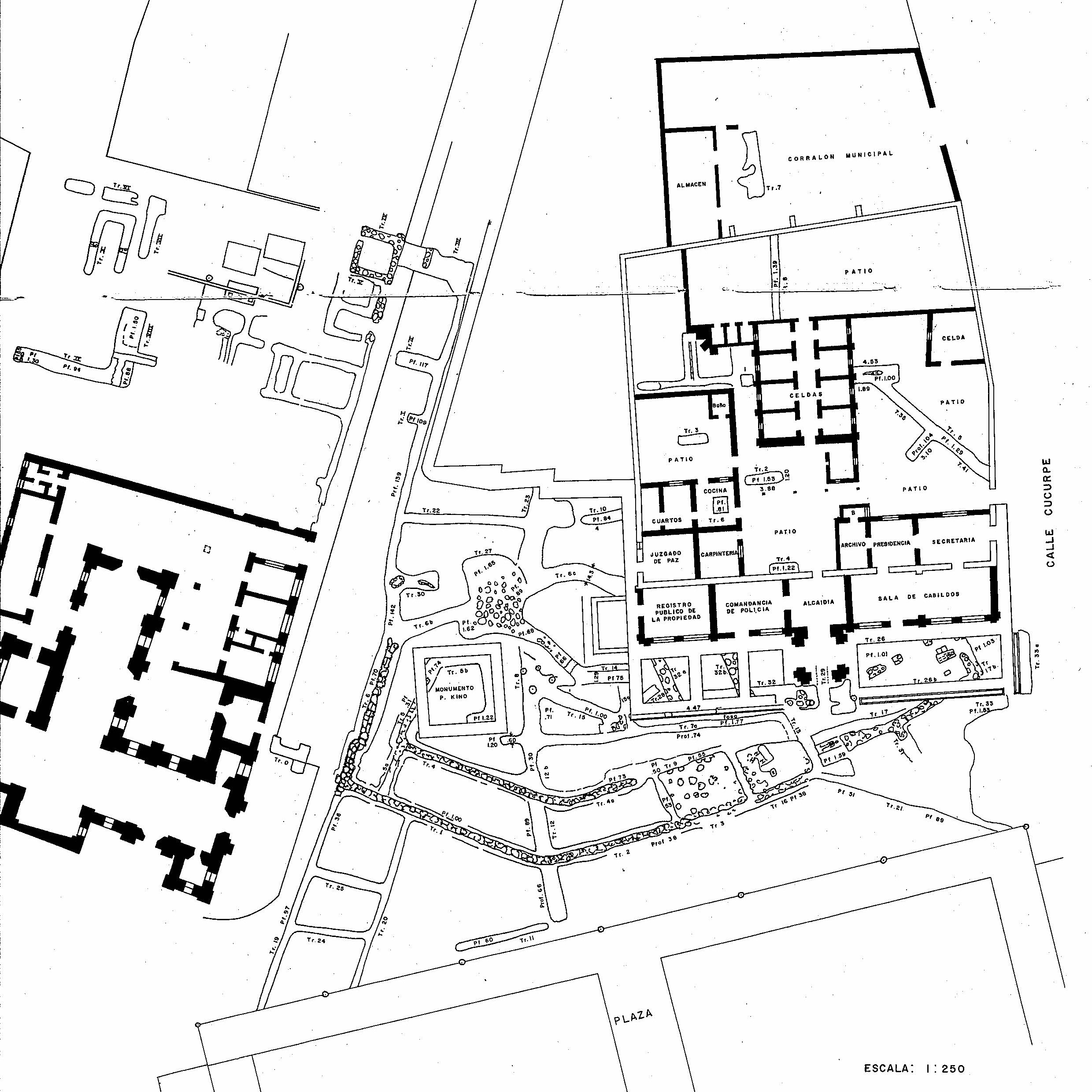
Drawing of Locations of Archaeological Excavations Figure 36
The Historic Center of Santa Maria Magdalena, Sonora
Topographical Engineer Conrado Gallegos 1966
Salvador de Noriega Remains Indicated by Skeletal Figure
The Compass Direction of North Is Towards The Lower Right Corner
Jesuit Foundations Made of Boulders & Clay-Mud Mortar Found Near Palacio Municipal
May 14, 1966 Saturday
Magdalena, Sonora
... From the day of his second arrival in Magdalena, Dr. Romano has be place in charge of excavations by Professor Jiménez Moreno, much to the relief of the rest of us.
The excavations inside the jail compound did not expose any old foundations as Sr. Rubén Parodi had though they would. A total of eighth trenches were dug were Professor Jiménez has conjecture that the Campos church and the chapel would be found, but with out any success. ... |212|
Even so, excavations in this trench were carried out with great zest |212| and by the prison inmates, who did a very good job. ...
During these days we began to locate some early Jesuit foundations while working the area in front of the Palacio Municipal toward the southwest corner of the building. The were made up of river boulders and mud and clay mortar. ... |213|
We started to dig inside the municipal jail as well as outside of it in front of the Palacio Municipal and in the area near the Kino monument with the aid of the jail inmates now, they were so enthusiastic about Kino that they helped us excavate outside the jail, returning inside at the end of their working day.
It was then that the people of Magdalena saw us going back and forth, inside and outside the jail, digging in what to them must have looked like a completely haphazard and crazy way. Every time we tried to get some rest by visiting the soda fountain, they would start to play on juke boxes all around the plaza the popular and humorous piece of music called “La Banda Esta Borracha”, "The Brass Band is Drunk." [Editor Note: To hear this very popular song, one of the most popular in 1966, click https://www.youtube.com/watch?v=WclkOKAYNGQ].
After two seasons of apparently unsuccessful excavations that must have seemed to them totally ludicrous, they were laughing and poking fun at us in this clever way.
During the days between the 12th and 14th of this month is when we started to locate the first Jesuit-period foundations. These discoveries quickly led us to other important ones. I had already started to find a large part of the southeast foundation of Kino's chapel while excavating its southwestern profile in Trench #17. Dr. Wasley had been excavating the area adjoining the east side of this wall when he decided to strip it ( Trenches #21, #31, and #33), and had even excavated its buttress without realizing it at the time. This was confirmed a few days later by historical documents found by Father Kieran McCarty.
The burial of a European was found in front of the portion of the foundations I had discovered, and the burial was already being excavated and studied by Professor Romano. ... |214|

Jesuit Buildings: Foundations of Boulders in Clay-and-Mud Mortar
With Walls Built With Sun Baked Adobe
Franciscan Buildings: Foundations of Quarry Stone and Lime-and-Sand Mortar
With Walls of Kiln Fired Adobe Figure 77
Jesuit Foundations Excavated Towards Palacio Municipal
May 16, 1966, Monday
Magdalena, Sonora; Remedios, Sonora
Professor Jiménez Moreno saw the advantage of the trip to Remedios. Because we would be examining the foundations and walls built by Father Kino himself, it could tell us definitely whether or not we were finding Jesuit structures in Magdalena. With the discovery of the possible foundations of Father Campos's church, our laborers were now better trained in the identification of Jesuit foundations. We had been trying all along to explain the difference between the natural earthen soil and the clay-and-mud mortar in Jesuit foundations. We also had the opportunity to show them the difference between these and Franciscan foundations, which were not made with boulders, but with quarry stone and lime-and-sand mortar. Franciscan walls, moreover, were made of fired brick, and not with adobe bonded with clay mortar. We had taught them how to excavate Jesuit foundations without destroying them, because the mud-and-clay mortar could be easily mistaken underground for natural hardened earth. We had already trained them to be able to detect Jesuit foundations by the color of the mortar, its texture, its consistency, its composition, etc. ... |217| ...
When we arrived in Magdalena, we were greeted with very good news. Professor Jimenez Moreno, who had stayed in Magdalena overseeing the excavations, had discovered the north right angle corner of a Jesuit type of foundation that the excavators were following towards the north near the clock tower of the Palacio Municipal. The laborers were following a footing built of boulders and clay-and-mud mortar, or “zoquete,” as Sonorans call it, that I considered could be the foundations of the Kino chapel. When they arrived at the end of this foundation, Professor Jimenez Moreno saw that at that very point the footing turned towards the left, forming a right-angled corner (see Fig. 36).
I think that all of us present when this good news was given to us were pretty happy about it. Our hope of finding Father Kino's remains had greatly increased. We would no longer be teased with the juke box music, "The Brass Band Is Drunk." ... |223| Palacio Municipal in a westward direction, clearly indicated the foundation formed part of a rectangular building. Recalling the overlay I had made of the Pinart sketch and old photograph, it seemed to me, especially, the position of these foundations in relation to the clock tower indicated they were those of the chapel of St. Francis Xavier. ... |223| ...
During these last days of our excavations and archival research work, an incredible amount of data, including documents, rained on us as if from heaven with amazingly good information. At the same time, the early Jesuit foundations were showing up and their shapes and ground plans were putting themselves together like the last pieces of a difficult jigsaw puzzle.
Jimenez Moreno's discovery cheered us up. The turn in the foundation, now headed towards the Palacio Municipal in a westward direction, clearly indicated the foundation formed part of a rectangular building. Recalling the overlay I had made of the Pinart sketch and old photograph, it seemed to me, especially, the position of these foundations in relation to the clock tower indicated they were those of the chapel of St. Francis Xavier.
The new trench in which the workers found the turn of the foundation, followed in Trench #17 and continued in Trench #26b, was labelled by Jimenez Moreno as Trench #17b (see Fig. 36). The workers |224| were told to continue the excavation in this new trench towards the Palacio Municipal. I could see that if this foundation happened to continue in the direction of the Palacio Municipal, our excavations would probably run right into the council chambers. What would happen then? If the foundations continued in that direction, we would probably have to tear down the entrance to the Palacio Municipal. Already the mayor was entering his office through a side door on Calle Cucurpe. Fortunately, the enthusiasm and cooperation of the authorities was such that the mayor himself, Sr. Gerardo Nava Garcia, told us, "If necessary, you can excavate under my own desk." ... |225|
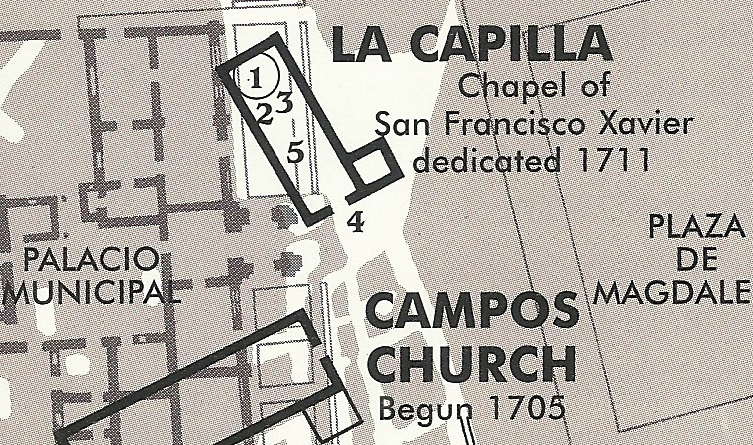
Kino Chapel Burial Excavations Correspond to Church Burial Records
(1) Kino (1711). (2) Gonzáles (1712). (3) Iturmendi (1712).
(4) Noriega (1739). (5) Vega (1837).
Kino Chapel Burials Including Salvador de Noriega's Burial at Front Door 1739
May 17, 1966 Tuesday
Magdalena, Sonora
The Jesuit foundations, probably those of the Campos church and of Kino's chapel, were now showing up. The historians were now finding more information on the St. Francis Xavier chapel, with different kinds of burials made inside and outside of it, but especially inside and at different periods. Encouraged by this good situation, Dr. Wasley and I concentrated our workmen in the area located northwest of the corner found by Jimenez Moreno. We were almost sure we would soon find the other corner of this structure. If so, it would most probably be the chapel in which Father Kino was buried.
Among the documents being found in the nearby parish archives were many describing burials made inside the San Francisco Xavier chapel. Among the more important ones, besides that recording the 1837 burial of the 90-year-old Indian named Jose Gabriel Vega, already mentioned, was the 1739 burial of Salvador de Noriega, a Spaniard, who "was buried in front of the door of the chapel of San Francisco Xavier in Magdalena."
Several other burials were made inside the chapel of St. Francis Xavier. Most of the records of these were found by Jimenez Moreno, Sanchez de la Vega, and Father Cruz Acuña, but I found records of three of them myself:
“Year of 1740
“On the 21st of June Francisco Xavier, child son of Ignacio Tapia and Chepa de Orozco servants of Lorenzo Velasco, died and was buried in the chapel of Sn. Xavier by me.
“On the 18th of October a small child of Philipe and Rosa de Acuña servants of Joseph Moraga died they have not had the courtesy of giving me his name they buried him in the chapel of Sta. Magdalena. |225|
“On the 2nd of November Maria de la Asumpcion, child daughter of Don Miguel de Mendoza Castellanos and Dona Josepha de Vreas, died and was buried in the chapel of San Francisco Xavier in Santa Magdalena. ”
[Gaspar Stiger Jhs] ... |226|
Fernando Grande's Report with Description of Kino Chapel 1828
May 18, 1966, Wednesday
Magdalena, Sonora
One of the last foundations still being excavated, oriented northwest to southwest right in front of the entrance to the council chambers (Sala de Cabildos) in the Palacio Municipal, we are almost sure corresponds to the west wall of the chapel of St. Francis Xavier.
Now we can be virtually certain. From among the documents Father McCarty recently brought from San Xavier del Bac in Tucson, he showed us one today strongly supporting our hypothesis -- one that became our first choice two days ago when Professor Jimenez Moreno discovered their northeast corner -- that these foundations are those of the chapel. The document is a transcript copy made by Father McCarty himself of a holograph report by don Fernando Grande, a man who had been sent by the Sonoran vice governor to inspect the missions' economic condition. Titled "Cartas de Sonora" and dated 1828, the original was then extant in the archives of the Colegio de la Santa Cruz de Queretaro.
I am reproducing the original text in Spanish, followed by an English version:
DOCUMENTO NUMERO 19 --1828 [San Ignacio] FABRICA MATERIAL. CAPILLA AYUDA DE PARRA QUIA DEL PUEBLO DE SANTA MARIA MAGDALENA VISITA DE LA MISION DE SAN IGNACIO. -- FABRICA MATERIAL. La Capilla de este pueblo es mediana su materia es de adobe su portada al medio dia presenta una torrecita mediana en que estan colocadas tres campanas y una esquila mediana, no tiene cosa particular que llame la atención, el Altar principal y único esta en el Presbiterio, en el estan colocados una Imagen de Cristo Crucificado con otro de la Virgen de Dolores al pie de talla mayor una menor y la otra de regular escultura y en unos nichos que enforma de retablo hay en la pared del altar estan colocados la Imagen de Santa Magdalena, Patron a del Pueblo, de talla menor buena escultura, un San Francisco Xavier y un Beato José Oriol, ambos de talla y de imperfecta escultura. A medio cuerpo de la Iglesia esta un nicho donde esta colocada en una Urna una Imagen de talla mayor de San Francisco Xavier |228|, objeto de la devoción de toda esta parte alta de Occidente, de hermosa y grave escultura.
DOCUMENT NUMBER 19 -- 1828 [San Ignacio] MATERIAL STRUCTURE. VISITA [mission station] CHAPEL OF THE PUEBLO OF SANTA MARIA MAGDALENA VISITA OF MISSION SAN IGNACIO. MATERIAL STRUCTURE.
The Chapel of this pueblo is of medium size, its material is adobe, its portal faces south and displays a small medium sized bell tower in which there are three bells and a small one. It hasn't any particular attraction. The main and only altar is in the sanctuary. In it are placed an image of Christ Crucified with another one of the Virgin of Dolores at the foot [of the Crucifixion] of a large size carving; another one of minor carving and another of a regular-sized sculpture. And in niches which are in the form of retablos in the wall of the altar are placed the image of Santa Magdalena, patroness of the pueblo, a minor but good sculpture, as well as a San Francisco Xavier and a beatified Jose Oriol, both carved but of imperfect sculpture. In the middle of the church nave there is a niche in which a large sized image of San Francisco Xavier is placed, a beautiful and solemn sculpture that is an object of devotion in all this upper [northern] part of the West.
There are several things which I wish to point out in relation to the chapel of St. Francis Xavier. In the first place, we have a very good drawing of what remained of this chapel in 1879 when Alphonse Pinart sketched its ruins. He was the first and last one to depict it before it completely collapsed after the 1887 earthquake. In what is left of its small bell tower, we can still see that the upper stories of the tower had mudejar chamfered corners and stilted arches of Muslim origin, a tradition continued by Franciscans in the bell towers of San Xavier del Bac and, until they were altered by modern priests, on the original bell towers of the present parish church of Magdalena as can be seen in the Pinart sketch (Fig. 50).
Some of the small sculptures that Fernando Grande mentions in his description of the chapel of San Francisco Xavier in Magdalena, including that of José Oriol, are now in the custody of the Mission of San Ignacio (see Fig. 74). The oldest are real works of art dating from the 17th and 18th centuries. ….
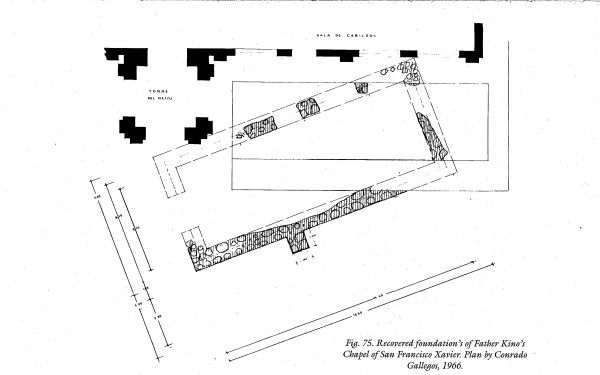
Recovered Foundations of Kino's Chapel Figure 75
Plan by Topographical Engineer Conrado Gallegos - 1966
Above Kino Chapel Foundations Is The Palacio Municipal with Clock Tower to Left
Father Perez Llera's Buttress Projects Outward From Lower Wall
Kino Chapel Found
While I was taking photographs of the area in front of the Palacio Municipal from the top of the clock tower, my workers digging in Trench #17b came upon the corner opposite that discovered by Jimenez Moreno. The trench now turned toward the south, making sense of the three isolated fragmentary foundations located in that direction (see Fig. 36, general ground plan of the area in front of Sala de Cabildos) and letting us know they were part of the west wall of a rectangular structure that could very possibly be the chapel. The complete outline of these foundations was now being revealed.
With the corner just found turning towards the south rather than continuing west, the threat to the entrance to the Palacio Municipal was eliminated. This made everyone happy, especially the mayor. I was the happiest, because I was now sure that these foundations were not |230| those of a larger building, such as that of the Campos church, but of a much smaller one. Aided by Conrado Gallegos, and starting from the isolated foundations, I now measured the inner width of the structure. It was approximately 5 meters. We then measured the approximate length of this rectangular structure along its east wall since the west one was incomplete in most parts. The length was 16 meters. As soon as we transferred the measurements onto paper, we saw they accorded with the normal size for a chapel.
As the foundations of the north end of the structure indicated a closed unit, with no gap for a door, we deduced that access to this building would be on its south end. Careful excavations were then carried out in this section. The absence of stone foundations on the south side -- with the exception of a few foundation stones that turned in a westward direction from the southeast corner, assured us that the entrance to the building was on the south, and that it was flush with the starting surface of the east foundation (see Fig. 75, recovered foundations of the chapel).
No foundation stones were found on the west corner of the structure. That area had been greatly disturbed when the clock tower of the Palacio Municipal had been built, and for the same reason, when the facade of the Palacio Municipal and its entrance were built, that other area had also been disturbed. That is why we found the west foundation of the structure in such a fragmentary condition, as can be seen in the illustration (Fig. 75).
Nevertheless, now that the foundations of our hypothetical chapel had been found, we saw that they adequately matched Fernando Grande's description of the chapel of San Francisco Xavier.
In fact, everything matched Fernando Grande's description: the walls that rested on the foundations we had now discovered, in their almost complete form, were of adobe. Not a single vestige of burnt brick had been found. The portal, as Grande wrote, faced south. The building was, as he said, medium sized, and, as we discovered later, it had a bell tower as he had indicated.
The archaeological crew uncovered a burial precisely in the spot where, if this were Kino's chapel, the historical researchers had indicated there should be the remains of a Spaniard, Salvador de Noriega, buried in 1739. If I were right in considering this area to be the south end of Kino's chapel, then the burial, discovered by Dr. Romano and which was currently being excavated by him, was surely that of Salvador de Noriega and the structure behind it was the long lost chapel of San Francisco Xavier.
… |231|
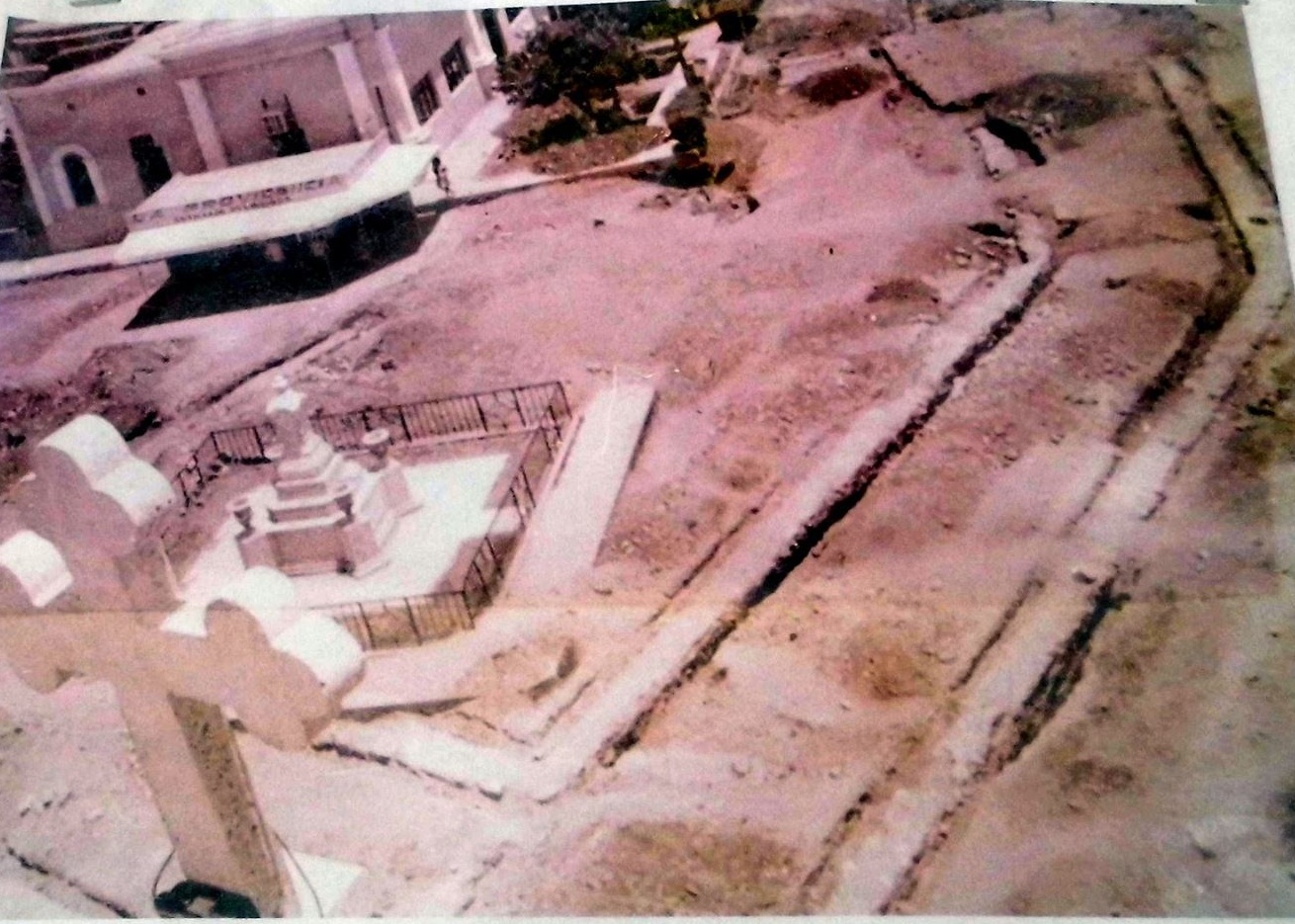
Raft Foundation of Campos Church Tower
Square Stone Slab in Upper Right Corner of Photograph
View From Church Roof, Kino Monument (center left), Palacio Municipal (upper left)
Raft Foundation of Campos Church Bell Tower Built for Unstable Ground
Professor Romano ordered his crew to strip the large ancient concrete slab, in front of the burial he was working on, a burial Dr. Wasley and I suspected was that of Salvador de Noriega. Initially, I had thought this concrete slab might belong, as I've said before, to the cobblestone space of a small plaza adjoining the end of the Franciscan foundations. But later on, when we knew from the documents brought by Father McCarty, that the Franciscan Perez Llera had added three rooms to the "house of Magdalena," and that the "house" or rectory abutted the bell tower of the Campos church, I had no doubt,that the huge stone slab was the raft foundation probably built by Kino for the bell tower of Father Agustin de Campos's church. ... |232|
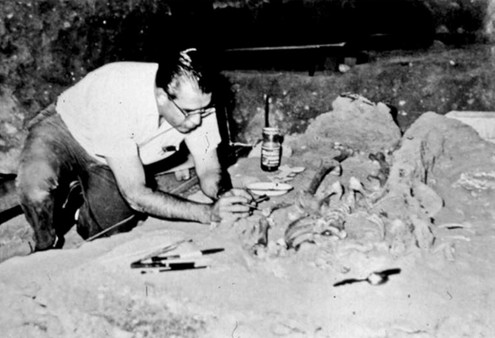
Arturo Romano Pacheco, Head of the Department of Physical Anthropology, INAH
Exposing Kino's Skeleton With Kino's Skull In The Laboratory
Grave and Skeleton of Suspect #2
Kino Chapel Wall Buttress
May 19, 1966 Thursday
Magdalena, Sonora
Professor Romano finally finished very neatly exposing the skeletal remains found in Trench #17. We now could see because of their position with respect to the foundations of the structure that seemed to be Kino's chapel that there was little doubt the remains were those of Salvador de Noriega.
Just as I was about to take some photographs of the recent excavations from the highest part of the clock tower, including those of the presumed chapel, the raft foundation, and the burial discovered by Professor Romano, my camera suffered some damage. It would have to be taken to Tucson to be repaired.
I put this problem aside, and seeing that Professor Romano needed some help, I gave him a hand with the final touches in exposing the skeletal remains of Burial #1. While all of us were eagerly engaged in our own tasks, Dr. Wasley called us to look at a just-discovered skull that appeared to belong to another interment beginning to be uncovered in the area of Trenches #26b and #17b. The discovery had taken place precisely at 4:30 P.M.
One of the laborers, Francisco Xavier Varela, and a co-worker, Rigoberto Medina, had come upon the skull. Unfortunately, when one of them had sunk his pick into the ground, the tip of the pick had hit the skull and caused a fracture (Fig. 76). .. |233|
Professor Romano started carefully to clean the skull in situ, and he directed the laborers to concentrate in the area of the discovery, being sure to excavate around it with the greatest care. They were to stop whenever they found bones. For Professor Romano, this was an extraordinary skull from many points of view. It could even be that of Father Kino. He told us he would have to study it thoroughly, and that he would now excavate the rest of the skeleton.
Since I could no longer take photographs because of my damaged camera, I also joined the historians working in the parish archives. It was then I found the document stating that in 1828 Father Perez' Llera added a buttress to one of the chapel walls that was in danger of collapse.
The document is titled, “Apuntes sobre los acontecimientos acaecidos en esta Colegio de la Santa Cruz de Queretaro desde el ano de 1821y sus Misiones basta el mes de Diciembre de 1844” [Jose Maria Perez Llera, 0.F.M.].—A.F.S.C.Q.Q. (McCarty collection).
The original Spanish reads as follows:
"Entre las necesidades que padecían aquellos pueblos era de las mayores amenazar ruina la iglesia de Magdalena [la capilla] en que se venera una imagen de San Francisco Xavier [5] quien con los beneficios abundantes que derrama en todos los habitantes de Sonora se ha granjeado la mayor veneración. Emprendi luego ver cómo evitar se viniere abajo y tal vez ocasionare esta desgracia; pero como no contaba con otra cosa que una limosna de la Mitra y gastos del culto, y otras indispensables, sólo pense echarle un estribo que contuviera la pared que estaba desplomandose. . . ."
My English translation follows:
"Among the necessities that those pueblos were suffering, one of the major ones was that the church of Magdalena [the chapel] where an image of San Francisco Xavier is venerated was menaced with ruin. With all the bountiful benefits that it pours upon the inhabitants of Sonora, the image has won the greatest veneration. I immediately thought of preventing the chapel's collapse which could probably have a tragic ending. |234| But as I didn't count on anything but some alms from the bishopric, and some fringe benefits paid by the neighbors and from where my subsistence came, with other expenses for indispensable things and for those involved with the devotion I could only add a spur which would support the wall that was already leaning over . . "
In Spanish, the word "estribo", which literally means "stirrup," has, like the English word "spur," several different meanings. In this case, through the context we know that Father Perez Llera was using the word estribo to refer to a buttress. |235|
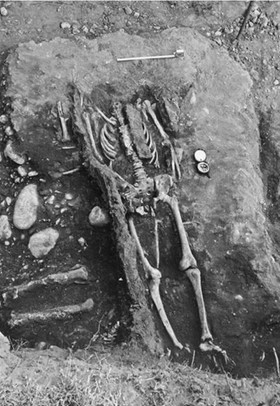
Reinterred Remains In Boxes on Each Side of Kino
Secondary Burials of Father Manuel Gonzaléz (lower left) & Father Ignacio Iturmendi
Kino Skeleton In Situ With Skull Removed For Laboratory Analysis
On Each Side of Kino Grave: Gonzalez and Iturmendi Secondary Burials Found
May 20, 1966, Friday
Magdalena, Sonora
Today I left very early for Tucson to have my camera repaired. I would also use the trip to buy some drafting materials for our draftsman, Conrado Gallegos, who needed them urgently.
By the time I returned from Tucson in the afternoon, Dr. Romano had managed neatly to lower the level of the excavation of Trench # 17b to the point where the skeletal remains of Burial #2 (which someone now called "Suspect Number 2") could be completely exposed. It was already evident these could be the remains of Father Kino. They were on the Gospel side of the chapel near where the altar would have been. Both Dr. Wasley and I shared this opinion, and Dr. Romano seemed to agree with us.
It was also on this day that the bones of two secondary burials, almost certainly those of Fathers Gonzalez and Iturmendi whom Father Campos had disinterred from Tubutama and reburied here in 1712, were found on either side of the extended primary Burial #2. … |235|
Kino Grave and Skeleton Found
Wasley Summarizes Field Evidence
May 21, 1966 Saturday
Magdalena, Sonora
While working in the area adjoining the clock tower of the Municipal Palace, and when excavating the area facing Dr. Wasley's recent discovery of a Jesuit type of foundation, I found another boulder and mud-and-clay mortar foundation that ran parallel to his and towards the area of the cobblestone raft foundation. This foundation appeared in Trenches #32 and #32b (Fig. 77). Now that the two foundations could be clearly seen and measured, the width between them and the span of what would have been the nave proved to be much larger in comparison with those of the other Jesuit structure which we now thought was the chapel. The distance between the two foundations |235| was approximately 5.60 m., a reasonable width for the nave of a medium-sized church. I also measured the width of the foundations of the structure we were now calling the chapel, measuring the segment exposed in Trench #26 in front of the right hand column of the clock tower of the Palacio Municipal. It was 1.05 m. wide.
The skull, which had been called "extraordinary" by Professor Romano, had now been transferred to the room in the Palacio Municipal where the municipal archives were kept. The room had been turned into a physical anthropology laboratory where Professor Romano began to study the skull with sophisticated anthropometrical instruments he had brought from Mexico City. He was now dividing his time between the study of the skull and the excavation and extremely neat exposure of Burial #2.
Suspecting that these remains could be Kino's, I also concentrated on careful exploration of the area of this interment. I looked for the rest of the foundations on the west side of the chapel and for any archaeological data or artifact that might strengthen the certainty this was Kino's chapel.
The entire team was working at a feverish pitch. While Dr. Wasley and I directed other excavations towards the north end of the chapel and Professor Romano took care of the interments, Professor Jimenez Moreno, Father Kieran McCarty, Sanchez de la Vega, and Father Cruz Acuña worked in the parish archives finding more documents supporting the identification of our archaeological finds.
In writing his report on the excavations, Wasley (1966) summarized nicely this correspondence between documentary and archaeological data.
The amazing finds were these:
"1) The historical researchers found documentary evidence that the Jesuit missionary Father Gaspar Stiger, a German [Swiss], had buried a Salvador de Noriega, in life employed by Lorenzo Velasco, just outside the door of the chapel of San Francisco Javier in Santa Magdalena, in August of 1739. The archaeological crew uncovered a burial in just such a spot with reference to one of the Jesuit period structures.
2) The historical researchers revealed that in 1828 the inspector Fernando Grande had stated - for the first time in all of the historical records that we know about - that the chapel faced to the south ("al medio dia") and that the archaeologists were able to determine from the foundations that this same structure did face to the south. It was much later, however, at the very end of the project and actually during the process of |236| winding everything up that Prof. Jorge Olvera finally found the foundations of the tower.
3) In this same document the historians were able to ascertain that the image of San Francisco Javier had been moved from the altar to about the midpoint of the nave of the chapel by 1828. The reason for this, we have to assume, was that the Fiesta de San Francisco Javier, celebrated annually and currently reaching an influx into Magdalena every year of an additional 10,000 people, had reached impossible proportions 140 years earlier in the tiny chapel, and the image had been moved to provide better traffic circulation through the chapel. In 1837, the historical documents reveal an elderly man of 90 years died and was buried inside the chapel in front of the niche of San Francisco Javier. The archaeologists found, at one side of the structure, about half way down the length of it, the burial of an old man with his feet towards the far side of the nave. The historical documents would seem to provide the identity of the burial, while the position of the burial would indicate that the image of San Francisco Javier, at the time that it was moved from the altar, had been installed on the west side of the nave.
4) The historical researchers found documentation to the effect that Father Pérez Llera was about to build a buttress to support one of the walls of the chapel. The buttress must have been built, because we found one outside the east side of the chapel. It was the only one we encountered ... "
It was through this kind of checking the documentary record against our archaeological finds that we were able to determine with certainty that we had found Father Kino's chapel. In the case of the identification of the buttress, I had noticed a few days earlier when Dr. Wasley was stripping his area that he had come upon a strange but salient feature on the east side of what was still then the hypothetical chapel. It was also made of river boulder ashlar stones mortared with mud and clay of the same color, texture, and consistency of the rest of the east foundation. For that reason, we determined to preserve it as part of the original footing. The 1828 document |237| of Father Pérez Llera had revealed that this feature was the buttress. …. |238|
In the afternoon of this same and very exiting day, I was helping Professor Romano with the final phase of carefully uncovering and exposing the remains of Burial #2. By then, Father Cruz Acuña, Dr. Sanchez de la Vega, and I thought this could be Father Kino (Fig. 79).
Dr. Wasley was helping to expose the lower limbs, and both of us, using great care, were removing the few surviving wooden fragments of the coffin. If these were the remains of Kino's wooden coffin, they were now more than 250 years old.
At this juncture, it becomes appropriate to quote—in my English translation—the final lines of an excellent article by Father Cruz Acuña (1966: 50) written after we had uncovered Father Kino's skeleton:
“Dr. Romano said: I think we have found him. . . . Professor Olvera, somewhat nervous, remained silent, or I didn't hear what he said. [8 ] Dr. Wasley, in spite of his scientific and critical spirit, uttered the phrase: "It is like a dream."
Sanchez de la Vega was the only one who smiled absolutely sure and satisfied. . . .
Sanchez de la Vega had been able to contain his emotions because from the moment we figured out that the ruins in Pinart's sketch were not the Campos church, but the chapel, he was sure we had found it , and that underneath its floor we would find Kino. Moreover, having participated in former amateur efforts to find Kino's remains, he had become involved in the more logical steps taken by Professor Jimenez Moreno's team. He had also been mentally compiling all the archival and archaeological discoveries and had been tracking our movements every step of the way.
I had felt a similar sense of assurance, especially after the revelation in the Pinart drawing and, in those last and exciting days, after it had occurred to me that the foundations of Father Perez Llera's school would eventually lead us directly to the chapel.
Footnote [8] This is true. The rest of the group stood near Father Acuña while I was aiding Dr. Romano, a short distance away, with Father Kino's remains. But in a near whisper, I said, "Look! This is a 17th-century cross on his left clavicle!" |239|
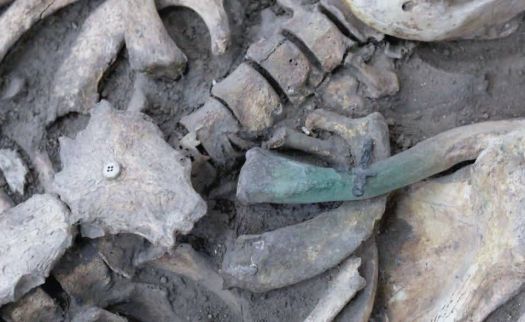
Kino's Discovery Remains With
Bronze Baroque Crucifix Found on and Discoloring Left Clavicle
In Addition To Cassock Button
Crucifix and Cassock Button Found on Kino Skeleton
Dr. Romano and I were still cleaning some of the upper bones of Father Kino's skeletal remains when suddenly, as I brushed away the remaining dirt and dust of past centuries, a beautiful bronze crucifix suddenly appeared on the left clavicle. It was exactly 5:55 P.M. The emotion was too much for me. Not only had we found Kino, but we had one more confirmation of his identity: the very crucifix Father Kino had worn on his chest! I was sure this was Father Kino's crucifix. Its baroque style and ornamentation confirmed that it was a 17th century work of art. …. |240|

Kino Discovery Team starting in front row from left to right:
Rev. Santos Saenz, Dr. William W. Wasley, Dr. Wigberto Jimenez Moreno,
Dr. Jorge Olvera, Dr. J. Matieila and Rev. Ernest. Burrus, S.J.
Not shown; Rev. Kieran McCarty, O.F.M., Dr. Arturo Romano,
Cronista Gabriel Sánchez de la Vega, Rev. Cruz Acuña Galvez and
Topographical Engineer Conrado Gallegos
Team Meeting: Burial #2 Is Father Kino's Remains
Professor Romano had been studying the skull of Burial #2 practically since the day of its discovery at 4:30 P.M. on May 19. Considering the new discovery of the crucifix, he arranged for a meeting of the whole team to discuss whether or not Burial #2 was in fact Father Kino. By now, the majority of us thought that the remains of this interment were those of Kino. The meeting was held in the archives of the Palacio Municipal which, by now, had been turned into the personal laboratory of Professor Romano for his physical anthropological studies, and especially for the study of the skull of Burial #2. This was a closed door seminar. By now, several reporters from the media both of Mexico and the United States had sensed a discovery, and they already suspected that either Burial #1 or Burial #2 could be Father Kino. They had begun to follow us like hounds in search of fresh and exciting news.
None of us wanted any publicity before discussing the question of the identification of the remains thoroughly, and as none of us with the exception of Dr. Romano were physical anthropologists, we felt unqualified from a truly scientific point of view to say whether the remains of Burial #2 were really those of Father Kino.
The matter of the two-secondary burials that had been found yesterday on either side of those of Burial #2 entered into our discussion. That these were almost certainly the bones of Fathers Gonzales and Iturmendi seemed clear from an entry made by Father Campos in the burial register in 1712. A photostatic copy of the entry had been found by our team of historians in the Magdalena parish archives." It reads as follows: |242|
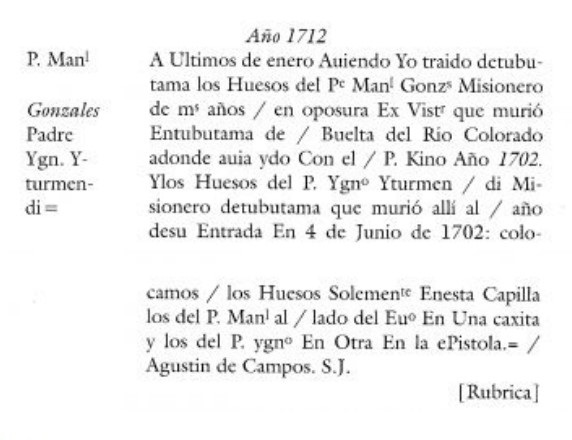
The English version is as follows:
The Year 1712
At the end of January, having brought from Tubutama the bones of Father Manuel Gonzales, missionary of many years in Oposura, ex-Visitor, who died in Tubutama on his way back from the Colorado River where he had gone with Father Kino the year 1702. And the bones of Father Ignacio Iturmendi, a missionary of Tubutama who died there the year of his arrival, on the 4th of June, 1702: We solemnly placed the remains in this chapel, those of Father Manuel on the side of the Gospel in a little box, and those of Father Ignacio in another one on the side of the Epistle.
Agustin de Campos [Rubric]
At this point, we were prepared to believe we had, beyond any shadow of reasonable doubt, located the chapel of San Francisco Xavier and, beneath its floor on the Gospel side of the altar, the mortal remains of Father Eusebio Francisco Kino: We were not, however, yet prepared to make the announcement to the world. That would have to wait for a few more days. |243|
The End of Jorge Olvera's Discovery Account
Finding Father Kino Excerpts
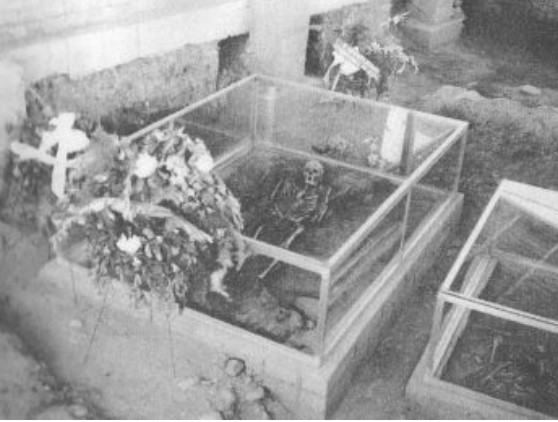
Protective Glass Cases Over Kino's Skeleton and
Reinterred Remains Father González and Father Iturmendi
After Finding Father Kino
Dr. Bernard L. Fontana
Afterword
Finding Father Kino ...
Father Burrus's seal of approval assured universal accpetance of the discovery's authenticity among historians and other scholars. With a skeptical local public, however, it was another matter. Not privy to the facts uncovered in archives and underground, ordinary people were less sure.
They knew none of the details of the configuration of the San Francisco Xavier chapel, including its south entrance, bell tower, and buttress and its relation to the Campos church; of the significance of the location in the chapel of Salvador de Noriego's bones and those of Fathers Gonzales and Iturmendi; of the evidence from the Pratt, J. Ross Browne, and Pinart sketches; of the importance of a baroque-style crucifix found on the clavicle; nor of the makeup of Jesuit-period foundations. …. Even to this day, doubters remain. And among those unwilling to avail themselves of the facts, there probably always shall. ...
[T]he early 20th-century builders of the Palacio Municipal had [no] ... idea they were close to destroying the evidence of Father Kino's chapel if not the bones of Father Kino himself. That Kino's remains were discovered in 1966 has to be regarded as miraculous. The same might be said for the continuation of so much that he set in motion in northern Sonora / southern Arizona more than three centuries ago.
Afterword
Dr. Bernard L. Fontana
Complier and Coordinator
"Finding Father Kino
The Discovery of the Remains of
Father Eusebio Francisco Kino 1965-1966
1998
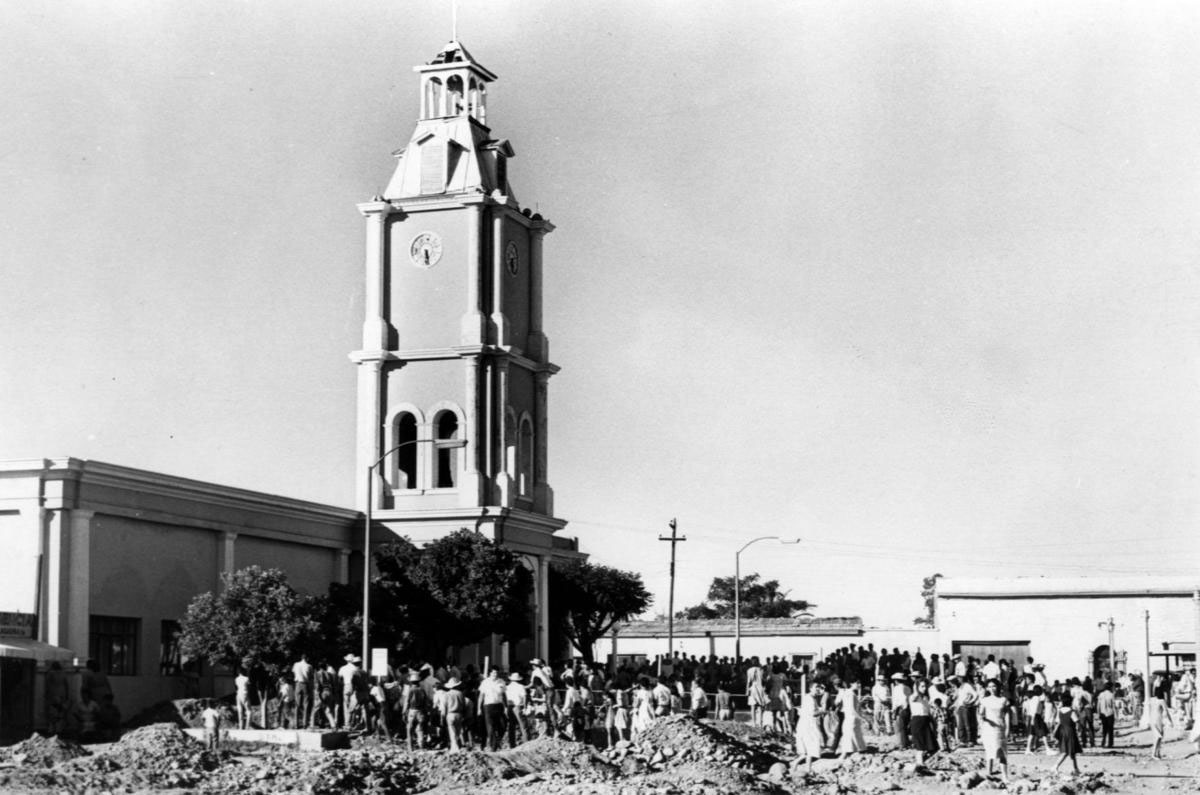
Sonora Celebrates Finding Father Kino
Crowds in Front of Palacio Municipal and Kino's Grave Site
Public Announcement of Discovery Made On May 24, 1966
[T]he archaeological evidence, supported to a considerable extent by historical documentation, has conclusively demonstrated that the remains of Father Eusebio Francisco Kino have been found." William W. Wasley 1966
Although the archaeological evidence, supported to a considerable extent by historical documentation, has conclusively demonstrated that the remains of Father Eusebio Francisco Kino have been found, neither archaeology nor history by themselves could have established this fact. On the other hand, the physical evidence of the burial itself (including orientation, the coffin, and the crucifix on the left clavicle) and the physical anthropological characteristics as interpreted as the skeleton by Prof. Arturo Romano would alone have established the fact that this was Father Kino. In other words, the nature of the burial establishes it as belonging to a priest or missionary, while the physical characteristics of the skeleton establishes it as belonging to a European of Alpine stock. As far as I have been able to determine no other priest of European ancestry and Alpine stock was ever buried in Magdalena.
William W. Wasley
Archaeology Notes on the Discovery of Father Eusebio Kino 1966
To download "Archaeology Notes on the Discovery of Father Eusebio Kino" written by Dr. William W. Wasley in 1966, Click Archaeology Notes on Discovery of Kino by Wasley
Charles W. Polzer
Pronouncement of The Mexican Academy of History
On May 24 the announcement was made to the general public; no doubt remained in the minds of any of the team or the experts called in after the initial conclusion was reached. The Reverend Ernest Burrus of the Jesuit Historical Institute at Rome, who luckily was visiting in Tucson, agreed in full. And finally on July14, 1966, the Academy of History met in Mexico City to review the evidence. Professor Jiménez Moreno presented seventy two depositions explaining the discovery. Then, Dr. Alberto Caso in the name of the Mexican Academy of History pronounced in favor of the identity of the remains. Padre Kino was found at last.
Dr. Charles W. Polzer, S.J.
The Discovery of Padre Kino's Grave
"Kino - A Legacy"
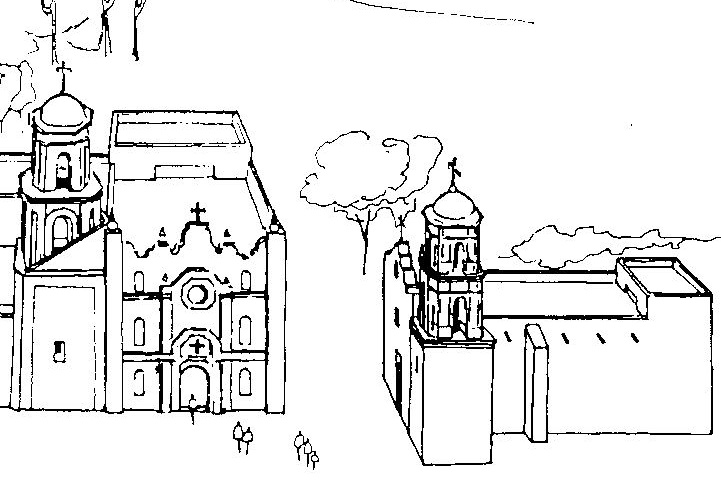
Campos Church (1706) (Left) and San Xavier Chapel (1711) (Right)
Kino's San Xavier Chapel Length: 54 feet (16.5 meters) Width: 23 feet (7.2 meters)
Foundation Width: 3.4 feet (1.05 meters)
Estimated Bell Tower Height: 28 feet (9.5 meters)
Campos Church Approximate Length: 70 feet (21 meters) Width: 20 feet (6 meters)
Measured Nave Interior Width 18.3 feet (5.6 meters)
Jorge Olvera - Concept Drawing - Conrad Gallegos, Topographical Engineer
Jorge Olvera
Kino Grave Discovery: Pioneering Historical Archaeology
... [W]e can now consider he subject of the archaeology which led to the discovery of his remains.
Historical archaeology was a new branch of archaeology, even in the United States, when we arrived in Sonora in 1965. Its very name denotes it as being distinct from prehistoric archaeology. Written documents are absent from prehistory, and the mysteries of prehistoric cultures lie buried beneath the earth hiding from the spade and trowel of the persistent looter called "archaeologist."
Historical archaeology employs the same sophisticated methods and scientific techniques of prehistory, many with high-sounding names. But its practitioners enjoy the added advantage of being able to avail themselves of ancient documents or even of recent ones. In our case, such documents were crucial in enabling us to fulfill the mandate of President Diaz Ordaz to locate the remains of Father Kino and to make their positive identification.
This enlightening experience taught us a great lesson: the success of an archaeological project depends on, and can even be measured by, the number of specialists who are on the team; that is, by the degree to which the research is interdisciplinary. The era of single-handed discovery and accomplishment is a thing of the past.
We learned, too, that the value of archaeology does not reside solely in tables, charts, numbers, and statistics; stratigraphic data; typological or quantitative analyses; sieving and flotation techniques; triangulation, sectioning, and dissection; radiocarbon dating; archaeomagnetic dating; dendrochronology; obsidian hydration; thermoluminescence dating; K/Ar fission track dating; USD dating; remote sensing; seriation; |54| typological structures; relative and absolute chronologies; geloflotation; froth flotation; etc. etc. All these aspects of modern archaeological methodology are valid in their place, but there is more.
There are different kinds of archaeology: classical archaeology; Biblical archaeology, now divided into Old and New Testament archaeology; archaeology of prehistoric North American and Mesoamerican Indian cultures; of the Mayas and of the Inka; and now of every region of the world. Having begun principally in Egypt with the Egyptologists, and after having travelled around the world, archaeology is now returning to that country to find out about the post-pharaonic tribes of Egypt about whom, comparatively speaking, almost nothing is known.
The technological advances in modern archaeology are amazing. Each day new and more scientific means of detecting ancient cultural deposits and of processing the excavated data of the past are developed. In this proliferation of scientific aids, however, there is the danger of archaeologists' losing sight of the humans who manufactured, distributed, and used the artifacts. The scientific means, if one is not careful, become the ends in themselves.
In 1965, however, the technological tools available to archaeologists were primitive by today's standards. One might almost say that we were able to find Father Kino's remains by dint of our intellects and hands alone.
Ours was a venture—among the pioneering ventures in Mexico—in historical archaeology, a discipline whose subject matter is closer to the present than to a distant past. Those whose lives historical archaeology seeks to understand—heroes as well as ordinary people and their many achievements—remain in our cultural memories and are nearer to us than the pyramids of Egypt.
Had the task of finding the remains of Father Kino been left solely in the hands of those trained as prehistorians or, as we say in Mexico, prehispanic archaeologists, it is possible they would not have succeeded. Prehispanic archaeologists would not have been trained to distinguish the different stages of Jesuit and Franciscan-period construction materials and techniques. Indeed, they might not even know such differences existed. Neither would they be able to identify and date the sherds of 17th, 18th, and 19th century historic ceramics as these were being unearthed.
It was his lack of this kind of specialized knowledge that contributed to the inability of Professor Davila to locate Father Kino's remains. In his final excavations in Magdalena he had very nearly succeeded, but he went to his grave never knowing the reason for his |55| failure. It was, we now know, because he mistook later Franciscan materials and foundations for the remains of earlier Jesuit constructions. It is unlikely Professor Davila, who was neither an historical architect nor art historian specialized in Spanish Colonial architecture, would ever have succeeded even had he been a professional prehistoric or prehispanic archaeologist.
The techniques employed in both types of archaeology are the same, but the background studies required in each profession are very different. I had practically to invent myself as an historical archaeologist at the time we started our search for Kino's remains. No such recognized discipline existed in Mexico before 1965 when we arrived in Sonora. It is, moreover, only recently that the Instituto Nacional Antropología e Historia has begun to show an interest in this specialized field. It was in 1988 that prehispanic archaeologist Patricia Fournier was sent by Mexico to the University of Arizona in Tucson to do post-graduate work in historical archaeology. In the process, she became her country's first professionally-trained person in this field.
Speaking on behalf of Professor Arturo Romano and myself, thanks to the Kino Project we became among the first practitioners of historical archaeology in Mexico. In this we were not so very far behind scholarship in the United States where, similarly, historical archaeology was only then emerging as an organized branch of study. [6]
...
It should be emphasized that in Mexico, as in the United States, there had earlier been projects which might now be classified as those involving historical archaeology but which were not conceptualized that way at the time. In the last century, when Mexico City's main square was being repaved, Antonio Garcia Cubas became one of the first historical archaeologists. ... |56|
Jorge Olvera H.
"Finding Father Kino:
The Discovery of the Remains of Father Eusebio Francisco Kino, S.J. 1965 -1966"
Editor Note: Olveras' discussion of historical archaeology was part of entry for
August 9, 1965 Monday, Hermosillo, Sonora.
Finding Father Kino's Grave - Two Page Summary Flyer


To View and Download "Finding Father Kino's Grave Summary"
Two Page Flyer, click
Summary Page 1
Summary Page 2
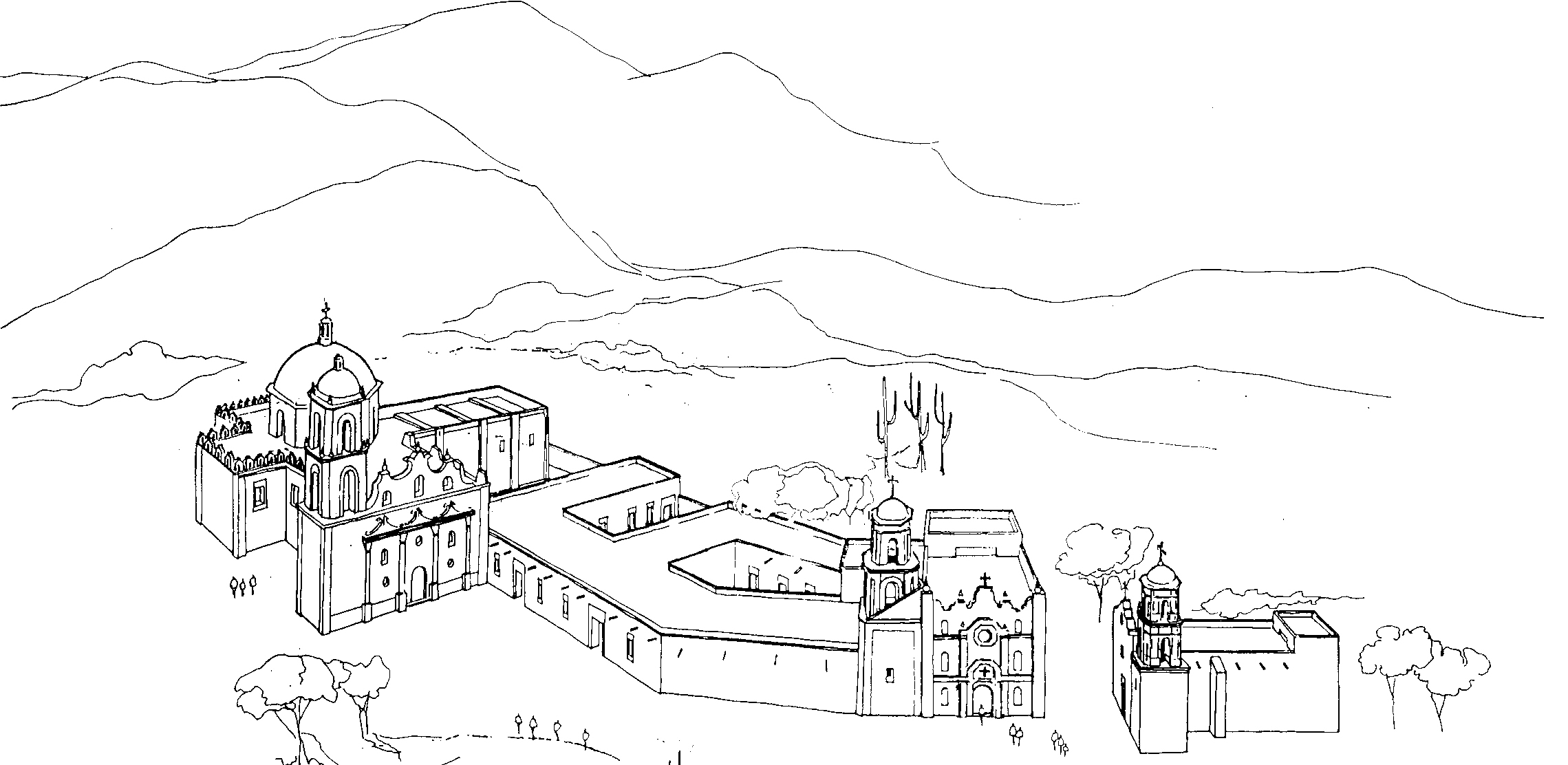
The Historic Center of Santa Maria Magdalena, Sonora
Concept Drawing Of Mission Era Buildings Through Time Jorge Olvera
Jorge Olvera Concept Drawing Of Mission Era Buildings Through Time
Buildings Identified From Right to Left.
Kino Chapel of San Francisco Xavier with bell tower and wall buttress (built 1711). Father Kino was buried in the chapel. Shown in the 1879 Alfonso Pinart drawing.
Campos Church with bell tower (built 1705-1706). Shown in the 1864 J. Ross Browne watercolor painting.
Campos Casa Cural or rectory (built 1705-1706). Father Kino died in the casa cural. The front wall extends in an in-line alignment with Campos Church's front wall. Shown in the 1864 J. Ross Browne watercolor painting.
Perez Llera's School of Grammar (built 1833) with its front wall extending in perpendicular alignment to the front wall of the Mission Church. Shown in the 1864 J. Ross Browne watercolor painting.
Mission Church of Santa María Magdalena, now present parish church (built 1832). The church is shown the 1864 J. Ross Browne watercolor painting. The church and Comellas' casa cural (built before 1876) is shown in 1879 Alfonso Pinart drawing.
The distance between the front of the Kino Chapel and the front of Mission Church of Santa María Magdalena is about 46 meters (147 feet). Olvera draws the buildings in their idealized best condition which does not reflect their historically dilapidated state. The remnants of the buildings were excavated and identified by the historical record.
To Go To Kino Grave Discovery Site History (page1), click
Grave Discovery Site History Page
To Go To Kino Grave Discovery Chapel (page 2), click
Grave Discovery Chapel Page
To Go To Magdalena de Kino - Trails Ends, click
Magdalena de Kino - Trails End Page